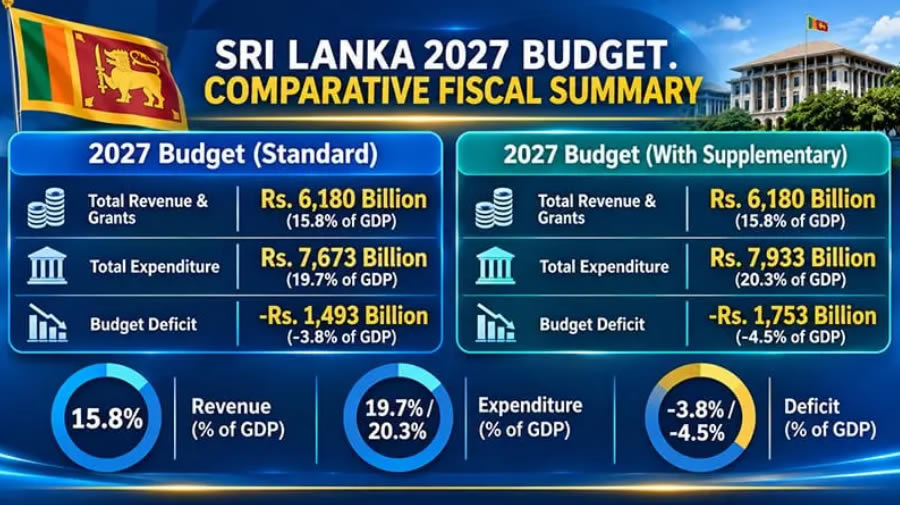





Sri Lanka's total government revenue and grants for the 2027 financial year are projected to reach Rs. 6,180 billion, according to the official Summary of Budget Estimates.
Of the total amount, government revenue is expected to account for Rs. 6,150 billion, consisting of Rs. 5,687 billion in tax revenue and Rs. 463 billion in non-tax revenue. A further Rs. 30 billion is anticipated through grants.
Tax revenue projections indicate that income taxes will contribute Rs. 1,341 billion, while taxes on goods and services are expected to generate Rs. 3,592 billion. Taxes on external trade are estimated to bring in another Rs. 754 billion.
Meanwhile, total government expenditure, including supplementary allocations for cyclone recovery, is projected at Rs. 7,933 billion. Without the supplementary estimates, expenditure is expected to amount to Rs. 7,673 billion, equivalent to 20.3% of Gross Domestic Product (GDP).
Recurrent expenditure is estimated at Rs. 5,944 billion. This includes Rs. 1,410 billion allocated for public sector salaries and wages, Rs. 2,643 billion for interest payments, and Rs. 1,482 billion for subsidies and transfers.
Public investment has also been increased to Rs. 2,000 billion, including supplementary provisions, representing approximately 5.1% of GDP.
The overall budget deficit, taking supplementary estimates into account, is projected at Rs. 1,753 billion, equivalent to 4.5% of GDP. At the same time, the government expects to maintain a primary surplus of Rs. 890 billion, or 2.3% of GDP.
To finance the projected deficit, the government plans to obtain Rs. 1,643 billion through net domestic financing, while the remaining Rs. 110 billion is expected to come from net foreign financing.
Budget 2027 Sets Out Economic Transformation Agenda, With Effective Implementation Crucial to Success
The Ceylon Chamber of Commerce has expressed optimism about the overall direction of Sri Lanka's 2027 Budget, stating that it supports the country's ongoing economic transformation while preserving policy consistency, macroeconomic stability and fiscal discipline.
According to the Chamber, maintaining this policy direction is essential as Sri Lanka moves beyond economic stabilisation and works towards establishing a sustainable, investment-driven growth model. While recognising several positive proposals aimed at improving national competitiveness and strengthening external sector resilience, the Chamber believes that additional attention to high-potential industries could further support economic expansion.
One of the key developments welcomed by the Chamber is the strong policy continuity between the 2026 and 2027 Budgets. Several structural reforms introduced in the previous year's Budget have been retained and further developed, offering businesses and investors a more predictable policy environment.
These initiatives include the ongoing development of the Trade National Single Window (TNSW), the gradual elimination of para-tariffs, implementation of the Digital ID framework, efforts to secure additional market access through Free Trade Agreements (FTAs), and improvements to investment facilitation through one-stop-shop mechanisms.
The Chamber also highlighted continued Customs reforms, the planned expansion of Bandaranaike International Airport (BIA), improved financing opportunities for small and medium-sized enterprises (SMEs), and reforms aimed at strengthening the management of State-Owned Enterprises.
More Than 20 Chamber Proposals Reflected in Budget 2027
The Ceylon Chamber further welcomed the inclusion of more than 20 proposals it had submitted for consideration in the 2027 Budget.
Among the measures reflected are the establishment of a professionally managed investment promotion agency to improve investor facilitation, initiatives to strengthen trade processes and export competitiveness, and the Government's consideration of a successor programme with the International Monetary Fund (IMF).
Other areas include accelerating important legislative reforms, expanding digital government services, encouraging cashless transactions and increasing the adoption of digital technologies.
Energy security has also received attention through proposals to speed up the deployment of Battery Energy Storage Systems (BESS) and strengthen fuel storage infrastructure.
In addition, the Budget incorporates measures concerning the productive use of underutilised agricultural land, the development of the digital economy and IT/BPO industries, and tax-related improvements for exporters. One such measure involves recognising newly VAT-registered businesses as eligible exporters.
The Chamber noted that the inclusion of these proposals demonstrates the importance of continued engagement between the public and private sectors and reflects closer alignment between government policy priorities and the requirements of a competitive, export-oriented economy.
Sri Lanka Budget 2027: Revenue Projected at Rs. 6.18 Trillion as Fiscal Deficit Targeted at 4.5% of GDP