




Fitch Ratings has downgraded the National Long-Term Rating of National Development Bank PLC (NDB) to ‘A-(lka)’ from ‘A(lka)’, while maintaining a Negative Outlook.
The rating agency also downgraded NDB’s Basel III-compliant subordinated debentures to ‘BBB(lka)’ from ‘BBB+(lka)’.
Fraud Incident Drives Downgrade
Fitch stated that the downgrade reflects a weakening in NDB’s credit profile relative to similarly rated peers, following a recently disclosed fraud incident. The agency noted that the issue has placed pressure on the bank’s capitalisation and profitability, while also highlighting deficiencies in internal risk controls compared to peers.
The Negative Outlook reflects ongoing uncertainty surrounding the investigation into the fraud and its potential impact on the bank’s operations, including possible changes to its business and risk profile.
Details of the Fraud Case
According to NDB, the fraud—announced on 2 April 2026—involved certain employees along with one or more external parties. A subsequent update on 6 April 2026 estimated the total exposure at approximately LKR 13.2 billion, equivalent to around 1.3% of the bank’s total assets as of end-March 2026.
Impact on Financial Performance
Fitch estimates that gross losses related to the incident could amount to about 2.3% of NDB’s risk-weighted assets as at end-2025. As a result, the bank’s core profitability metric—operating profit relative to risk-weighted assets—is expected to fall below 2% in 2025, trailing similarly rated peers.
While profitability is expected to recover over the medium term, Fitch cautioned that the incident could hinder the bank’s ability to meet its projected earnings targets.
Capital and Dividend Constraints
The impact of the fraud is also expected to reduce retained earnings, lowering NDB’s common equity Tier 1 ratio by approximately 1.1 percentage points from the reported 12.9% at end-2025. Although this remains above regulatory minimum requirements, Fitch noted that capital buffers will be thinner compared to peers, potentially limiting financial flexibility and loss-absorption capacity.
Fitch further expects the suspension of cash dividends—imposed by the Central Bank of Sri Lanka—to remain in place until the bank strengthens its capital buffers.
LankaPay, Sri Lanka Tourism Development Authority and Alipay+ Partner to Boost Tourism and QR Payment Adoption
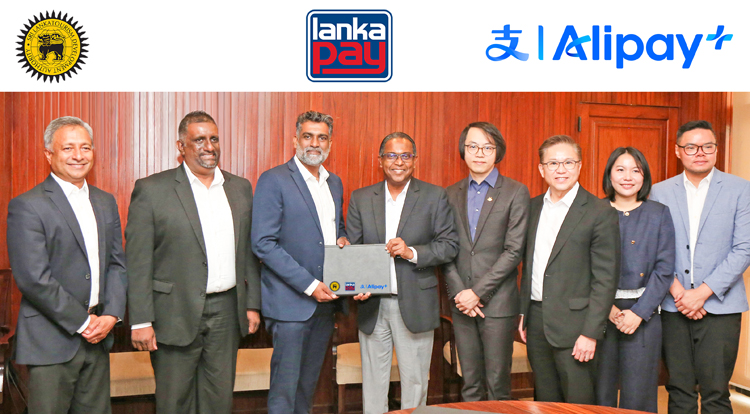
LankaPay, the Sri Lanka Tourism Development Authority (SLTDA), and Alipay+ have entered into a strategic collaboration aimed at enhancing Sri Lanka’s tourism appeal and increasing international visitor arrivals, particularly from Asia and the wider Asia-Pacific (APAC) region.
The partnership leverages the global ecosystem of Alipay+, Ant International’s unified wallet gateway, enabled locally through LankaPay, to position Sri Lanka as a preferred travel destination among international travellers. With access to over 40 international partners—including leading e-wallets and banking apps across the APAC region—reaching more than 1.8 billion user accounts, Alipay+ is expected to actively promote Sri Lanka through targeted campaigns designed to attract high-value tourists.
As part of the initiative, users of Alipay+ partner platforms will benefit from exclusive offers and promotions when making payments via LankaQR in Sri Lanka. These incentives are expected to influence travel decisions positively and boost tourist spending, contributing to improved tourism earnings.
In line with evolving global travel trends, the SLTDA has placed greater emphasis on attracting tourists from key Asian and APAC markets. This collaboration supports that strategic direction by enhancing Sri Lanka’s visibility and accessibility among priority traveller segments.
The initiative represents the first phase of a broader partnership between LankaPay and SLTDA focused on long-term tourism development. As a global partner of LankaPay, Alipay+ facilitates seamless cross-border QR payments, along with AI-powered in-app marketing and travel services—enhancing convenience for international visitors while accelerating the adoption of digital payments across the island.
In addition to driving inbound tourism, the initiative is expected to support local economic growth by encouraging micro and small merchants to adopt cross-border QR payment acceptance through LankaQR, Sri Lanka’s national QR payment network. This will enable businesses to better connect with global customers and participate more effectively in the expanding digital payments ecosystem.
Fitch Downgrades National Development Bank PLC to ‘A-(lka)’; Outlook Negative