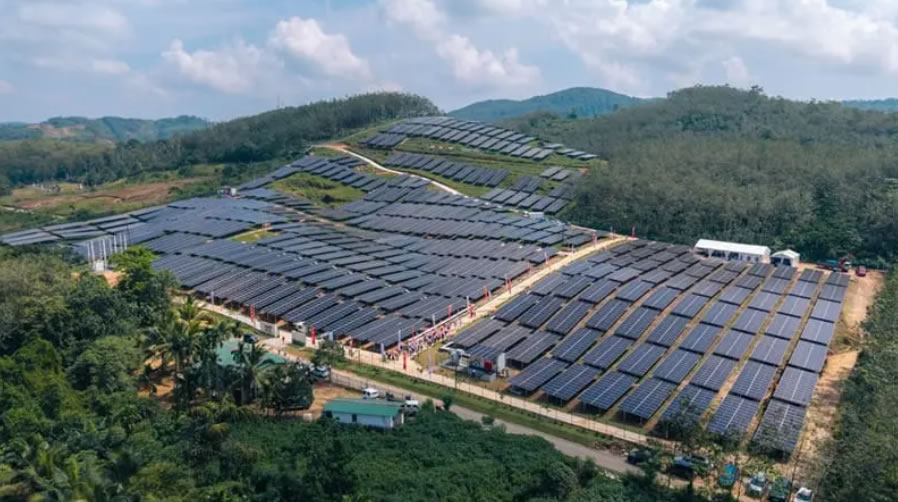





Hayleys Solar, the renewable energy division of Hayleys Fentons Limited, has officially inaugurated two ground-mounted solar power projects in Kosgama, marking another milestone in the company’s efforts to strengthen Sri Lanka’s renewable energy sector.
The developments comprise Kosgama I, with a capacity of 2MW, and Kosgama II, with a capacity of 3MW. Together, they represent the second phase of Hayleys Solar’s ambitious 300MW ground-mounted solar portfolio. Featuring 10,790 high-efficiency 640W solar panels, the projects are expected to produce approximately 9.9 million kWh of clean electricity annually while reducing carbon dioxide emissions by an estimated 6,930 tonnes each year.
The construction process presented several technical challenges, particularly due to limited access for conventional machinery across certain sections of the site. As a result, labour-intensive methods, including manual drilling and foundation preparation, were required. Through detailed planning and customised engineering solutions, Hayleys Solar completed the projects while maintaining the site's natural terrain and existing water drainage systems.
The Kosgama developments also reflect the Hayleys Group’s wider commitment to sustainable and responsible business practices under its Lifecode ESG framework. With Sri Lanka targeting 70% renewable electricity generation by 2030, the projects will contribute additional utility-scale renewable energy capacity to the national grid. They also build on the company's earlier Veyangoda development as part of its planned 300MW solar portfolio. Meanwhile, approximately 70% of the energy consumed by the Hayleys Group’s own operations is already sourced from renewable energy.
Commenting on the developments, Hasith Prematillake, Managing Director of Hayleys Fentons Limited, stated that the Kosgama projects demonstrate the company’s ability to transform complex engineering challenges into opportunities for sustainable development.
He also highlighted the community-focused dimension of the initiative through its ‘Hive for the Future’ programme, which promotes beekeeping, supports biodiversity and pollinator conservation, and creates potential livelihood opportunities for surrounding communities.
Roshane Perera, Deputy Managing Director – Energy at Hayleys Fentons Limited, noted that the Kosgama developments required a specialised engineering approach that differed from conventional ground-mounted solar installations. He emphasised the technical efforts involved in carrying out manual foundation work and adapting installation techniques to the site's natural landscape without disrupting existing drainage patterns.
The successful completion of the Kosgama I and II projects further demonstrates Hayleys Solar’s engineering expertise and reinforces its commitment to supporting Sri Lanka’s transition towards a cleaner, more sustainable energy future.
JKH Reports Rs. 7.95 Billion Profit Before Tax in Q2 2026/27, with Strong Increase in Attributable PAT

John Keells Holdings PLC (JKH) reported a Profit Before Tax (PBT) of Rs.7.95 billion for the second quarter of the 2026/27 financial year, recording a 2% year-on-year increase from the Rs.7.80 billion reported in the corresponding quarter of the previous financial year.
The Group’s profit attributable to equity holders of the parent recorded a significant 213% increase, reaching Rs.5.17 billion compared to Rs.1.65 billion in Q2 2025/26. This growth was primarily supported by improved operational performance across several key business segments.
Group earnings before interest, tax, depreciation and amortisation (EBITDA) stood at Rs.18.30 billion during the quarter, broadly comparable to the Rs.18.36 billion recorded in the same period last year. Improved contributions from most industry groups offset the weaker performance of John Keells CG Auto (JKCG), which faced a particularly strong comparative quarter following the resumption of vehicle imports. For the first six months of 2026/27, Group EBITDA increased by 11% to Rs.34.65 billion.
Group Profit After Tax (PAT) rose by 39% to Rs.5.82 billion, compared to Rs.4.20 billion in the corresponding period of the previous year. The appreciation of the Sri Lankan Rupee during the quarter resulted in a net foreign exchange impact of Rs.340 million on Group PBT. Excluding net exchange movements, PBT amounted to Rs.7.61 billion, compared to Rs.8.04 billion in Q2 2025/26.
Among the Group’s key developments, Colombo West International Terminal (CWIT), which operates the West Container Terminal (WCT-1), handled 502,351 TEUs during the quarter, exceeding the full utilisation capacity of its first phase. The terminal also became the fastest in the Port of Colombo to reach two million TEUs, achieving the milestone within just 18 months of commencing operations. Phase 2 operations have commenced through the gradual commissioning of equipment, with full operations expected by December 2026.
The Transportation industry group recorded higher EBITDA, supported by a strong performance from Lanka Marine Services (LMS). Its bunkering volumes increased by 31%, alongside improved margins and a stronger contribution from CWIT.
The Beverages and Confectionery businesses also delivered improved profitability, supported by volume growth of 10% in carbonated soft drinks and 7% in confectionery. The Convenience Foods business recorded further improvements in both volumes and profitability.
Meanwhile, the Supermarket business achieved 13% same-store sales growth, driven by increased customer footfall and higher average basket values. Despite rising electricity and distribution expenses, EBITDA improved marginally, reflecting the benefits of operational efficiencies and business scale.
As expected, JKCG recorded a moderation in performance against the exceptionally strong comparative period of the previous year, during which demand had been boosted by the resumption of vehicle imports. The business handed over more than 2,400 vehicles during the quarter.
The Leisure industry group experienced lower EBITDA contributions from Colombo Hotels and Maldivian Resorts, partly reflecting travel disruptions associated with the ongoing conflict in the Middle East. This was partially offset by improved profitability across the Group’s Sri Lankan resorts.
City of Dreams Sri Lanka continued its operational expansion, with improving performance across its key business segments. Higher hotel occupancy levels and average room rates supported growth in hotel EBITDA, while the casino business also demonstrated encouraging progress as operations continued to scale up.
The Property industry group recorded EBITDA growth, supported by profit recognition from residential and commercial property sales at Cinnamon Life, alongside residential sales at TRI-ZEN.
In the Financial Services sector, JKH’s share of profit after tax from Nations Trust Bank (NTB) increased, benefiting from a one-off tax credit associated with the acquisition of HSBC Sri Lanka’s retail banking business. However, part of this benefit was offset by integration-related expenses. Union Assurance (UA) also recorded growth in gross written premiums, primarily supported by renewal premiums.
On the sustainability front, although the Group’s overall carbon footprint and water consumption increased, operational intensity indicators across key businesses in the Consumer Foods, Leisure and Transportation sectors showed improved efficiency.
Separately, the Board of Directors declared a first interim dividend of Rs.0.10 per share, payable on or before 2 December 2026.
The latest results highlight JKH’s continued operational progress across its diversified business portfolio, with significant growth in attributable earnings during the second quarter of the 2026/27 financial year.
Hayleys Solar Strengthens Sri Lanka’s Renewable Energy Drive Through 5MW Solar Project in Kosgama