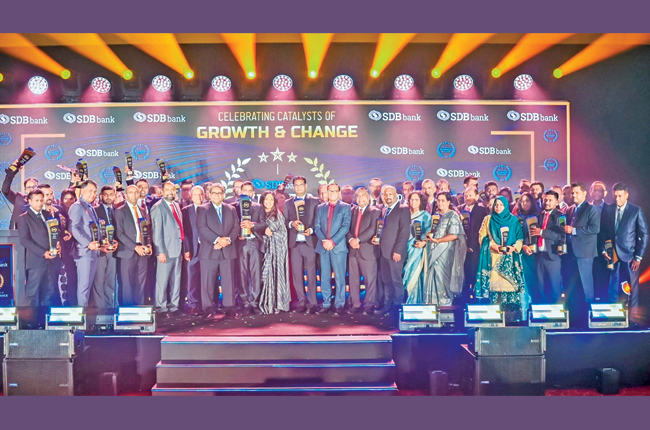





SDB Bank recently hosted the Business Awards 2025 under the theme ‘Celebrating Catalysts of Growth & Change’, recognising and celebrating the exceptional contributions and achievements of its employees throughout the year.
The event highlighted the bank’s commitment to building a motivating workplace culture while acknowledging the dedication, performance and innovation of employees who continue to drive the organisation’s growth and success.
Reflecting the strong performance achieved during the year, the Anamaduwa Branch was recognised as the overall best-performing branch, showcasing outstanding commitment and results. Meanwhile, the North Central Region was awarded as the best-performing region, with the Uva Region and Metro 1 Region receiving recognition as the first and second runners-up respectively.
More than 35 award categories were presented during the ceremony, along with special appreciation awards for supporting departments that contributed towards the bank’s overall performance.
Celebrating a Culture of Excellence
The Annual Business Awards have become a significant initiative within SDB Bank, reinforcing its commitment to recognising high-performing employees and encouraging a culture of excellence, innovation and continuous improvement.
Speaking at the event, SDB Bank Executive Director and Chief Executive Officer Kapila Ariyaratne said:
"Our employees are the driving force of SDB Bank. Their dedication, talent and hard work enable us to serve our communities and achieve our goals. The Annual Business Awards 2025 reflects our commitment to celebrating their success and creating a culture of recognition and appreciation."
He added that the bank looks forward to further strengthening the initiative and making it an eagerly anticipated annual celebration across the organisation.
Strengthening Employee Engagement
Aligned with its corporate tagline, ‘The Bank Where You Are Valued’, SDB Bank continues to focus on employee wellbeing, professional growth and creating a workplace where individuals feel recognised and empowered.
Through initiatives such as the Business Awards, SDB Bank continues to strengthen employee engagement while fostering a culture where dedication, innovation and excellence are consistently rewarded.
23rd Annual Geoffrey Bawa Memorial Lecture to Feature Renowned Architect Junya Ishigami
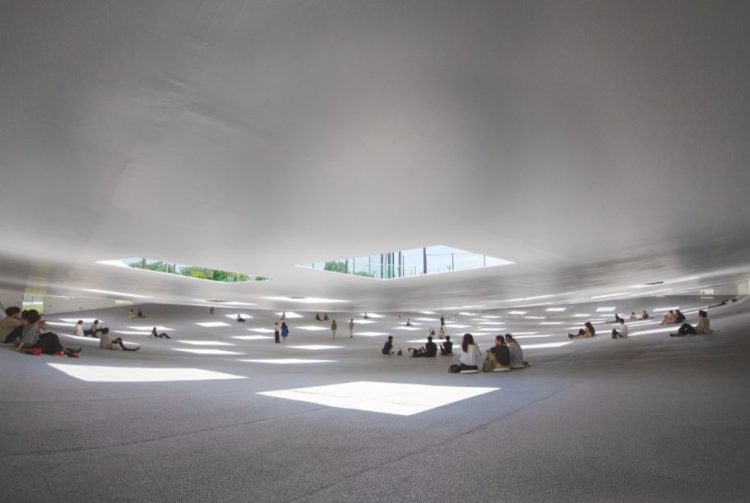
The Geoffrey Bawa Trust has announced that the 23rd Annual Geoffrey Bawa Memorial Lecture will be delivered by internationally acclaimed architect Junya Ishigami, celebrating his influential contribution to contemporary architecture and design.
Held annually to commemorate the birthday of legendary Sri Lankan architect Geoffrey Bawa, the Memorial Lecture brings together leading architectural voices from around the world to explore innovative ideas, creative practices and evolving perspectives in the field of architecture.
Junya Ishigami’s Visionary Approach to Architecture
Junya Ishigami, founder of junya.ishigami+associates, is recognised for architectural works that challenge conventional boundaries between nature, structure and the built environment. He completed his Master’s Degree at the Department of Architecture at Tokyo University of the Arts and gained professional experience at the renowned Kazuyo Sejima & Associates before establishing his own practice in 2024.
Ishigami’s designs explore the relationship between architecture, materials, climate and natural surroundings. Rather than treating buildings as isolated structures, his work creates environments where space, atmosphere and landscape interact over time.
Integrating Nature and Built Form
One of Ishigami’s notable projects is the Zaishui Art Museum in China’s Shandong Province, where architecture merges seamlessly with its surrounding landscape. The over one-kilometre-long structure combines concrete and steel elements with water, creating an immersive experience where reflections of the sky, trees and lake become part of the building itself.
Completed in 2023, the 20,000-square-metre complex functions as an exhibition space, visitor centre and shopping destination, demonstrating Ishigami’s unique approach to blending architecture with natural elements.
Another significant project is the Art Biotop Water Garden near Tokyo’s Nasu Mountains. The project combines carefully designed landscapes with natural elements by relocating an entire forest from a nearby development site. Featuring 160 ponds surrounded by 318 trees, including beech and quercus species, the garden creates a distinctive environment where artificial design and organic growth exist together.
Internationally Recognised Works
Ishigami’s other acclaimed projects include the Plaza at Kanagawa Institute of Technology, a 4,000-square-metre open-air space designed as a flexible gathering area for students; the 2019 Serpentine Pavilion in London; and the House & Restaurant in Japan, a partially underground structure that combines a private residence with a public dining space.
His innovative architectural philosophy has earned global recognition, including prestigious honours such as the Architectural Institute of Japan Prize, the Golden Lion Award for Best Project at the 12th International Architecture Exhibition – La Biennale di Venezia, the Mainichi Design Award, the OBEL Award, the Frederick Kiesler Prize for Architecture and the Arts, and the Arnold W. Brunner Memorial Prize.
Ishigami was also elected an Honorary Fellow of the American Institute of Architects in 2025, further recognising his global influence on contemporary architectural thinking.
Through the 23rd Geoffrey Bawa Memorial Lecture, Ishigami will continue the tradition of bringing exceptional international perspectives to Sri Lanka while honouring Geoffrey Bawa’s enduring legacy of innovative and context-sensitive architecture.
SDB Bank Recognises Outstanding Employees at ‘Business Awards 2025’