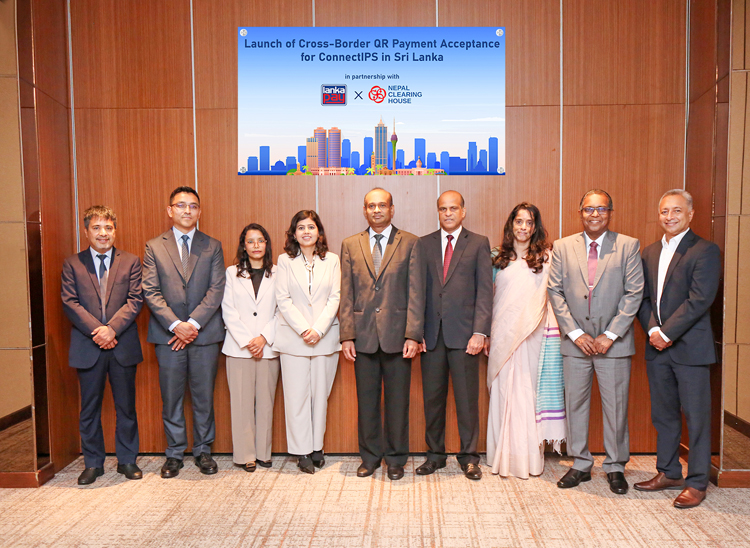





Sri Lanka and Nepal have taken a major step toward regional financial integration with the official launch of cross-border QR payment connectivity on 12 May 2026, enabling seamless digital transactions between the two countries.
The initiative allows Nepali travellers visiting Sri Lanka to make payments using their domestic digital payment applications — including mobile banking apps and connectIPS — at more than 400,000 merchants accepting LankaQR payments across Sri Lanka.
The launch was announced at a ceremony in Colombo attended by senior officials from the Nepal Rastra Bank, the Central Bank of Sri Lanka, Nepal Clearing House Ltd. (NCHL), and LankaPay. The project represents a significant advancement in South Asia’s efforts to build secure, real-time, and interoperable digital payment ecosystems.
The new arrangement enables Nepali users to scan LankaQR codes in Sri Lanka and make instant payments through participating Nepalese banking and payment applications. Transactions are processed through regulated payment infrastructure, ensuring security, speed, and convenience for both consumers and merchants.
Officials said the system is expected to enhance the travel experience for Nepali tourists and business visitors by removing the need for physical currency exchange, while also opening new opportunities for Sri Lankan merchants — particularly small and medium enterprises — to serve international customers more easily.
Speaking at the launch, Nepal Clearing House Ltd. CEO Neelesh Man Singh Pradhan described the partnership as a key step toward affordable and secure cross-border QR payments that strengthen regional interoperability. LankaPay CEO Channa de Silva also noted that the initiative marks an important milestone in expanding international payment connectivity and supporting seamless digital commerce in the region.
The collaboration reflects a broader commitment by both countries to promote inclusive digital financial services, boost tourism and trade, and deepen regional cooperation through modern payment infrastructure integration.
Sampath Bank reports Rs 6.2 billion PAT in Q1 2026 despite geopolitical headwinds

Sampath Bank reported a Profit After Tax (PAT) of Rs 6.2 billion for the quarter ended 31 March 2026, reflecting a 26% decline year-on-year, despite continued growth in core operating income and a strong expansion of its balance sheet.
The Bank’s Total Operating Income stood at Rs 28.5 billion, supported by steady gains in Net Interest Income (up 5%) and a strong 28% increase in Net Fee and Commission Income, driven by credit growth, higher trade activity, and increased card usage.
However, profitability was impacted by significantly higher impairment provisions of Rs 4.5 billion, reflecting the continued expansion of the loan book and adjustments for evolving geopolitical conditions. Additionally, lower one-off gains from the disposal of Treasury Bills and Bonds — down to Rs 0.7 billion from Rs 2.7 billion a year earlier — also weighed on results.
The Bank’s total asset base crossed the Rs 2 trillion milestone for the first time, supported by strong loan growth of Rs 127 billion during the quarter, marking a significant structural expansion.
Net Interest Income rose to Rs 20.1 billion, supported by increased lending volumes and an upward movement in the Average Weighted Prime Lending Rate (AWPLR). Meanwhile, Net Interest Margin slightly contracted to 4.09%, down 2 basis points year-on-year, mainly due to lower yields from the government securities portfolio.
Non-funded income declined marginally by 4% to Rs 8.3 billion, primarily due to reduced capital gains from government securities trading. However, exchange gains increased by 24% to Rs 1.5 billion, supported by Sri Lanka rupee depreciation of Rs 5.52 against the US dollar during the quarter.
At group level, Sampath Group recorded a Profit Before Tax of Rs 9.4 billion and Profit After Tax of Rs 6.8 billion for the period.
Overall, the results reflect a mixed performance — with strong underlying operating growth and asset expansion offset by higher provisioning costs and lower non-recurring gains.
Sampath Bank recorded a total impairment charge of Rs 4.5 billion in the first quarter of 2026, a sharp increase of Rs 4.6 billion compared to the reversal of Rs 0.2 billion in the same period last year, reflecting a significant shift in provisioning dynamics.
The impairment charge on loans and advances amounted to Rs 4.1 billion, compared to a reversal of Rs 0.1 billion in 1Q 2025. This increase was largely driven by a 10.4% expansion in the loan portfolio, which resulted in higher collective impairment requirements under expected credit loss models.
Despite the higher provisioning impact, the Bank noted that the loan growth is expected to contribute positively to earnings over the course of the financial year.
In addition, Sampath Bank adopted a more conservative risk stance by booking an extra overlay provision of Rs 1.5 billion as a prudential buffer against heightened geopolitical uncertainties. This forward-looking approach reflects a cautious credit risk strategy aimed at strengthening resilience against potential macroeconomic and external shocks.
The Bank also undertook a detailed review of its ISL (Individually Significant Loan) customers, making targeted provisions based on each borrower’s credit risk profile. This granular assessment underscores a disciplined approach to maintaining asset quality amid a challenging operating environment.
Meanwhile, impairment charges on other financial instruments stood at Rs 0.4 billion, mainly due to new investment exposures undertaken during the quarter.
Overall, the results highlight a conservative provisioning stance by the Bank, balancing strong loan book growth with increased risk buffers to safeguard financial stability in an uncertain global backdrop.
Sri Lanka and Nepal launch cross-border digital payment connectivity to strengthen regional financial integration