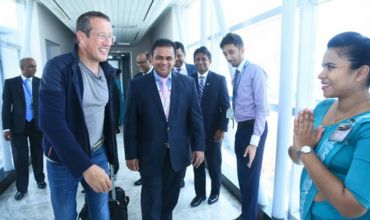
Richard Quest, CNN’s leading international business correspondent and presenter of the popular programme Quest Means Business, arrived in Sri Lanka today (19) to participate in the third edition of the Future of Tourism Summit (FOT 2019), scheduled to be held on September 23 at Cinnamon Grand Colombo.
Upon his arrival at Bandaranaike International Airport, Quest was welcomed by SriLankan Airlines Group Chief Executive Officer Vipula Gunatilleka, along with several senior management representatives of the national carrier.
Born on March 9, 1962, Richard Austin Quest is an English journalist and prominent CNN International anchor. Based in New York City, he also serves as CNN’s Business Editor-at-Large.
Quest is widely recognised for hosting Quest Means Business, CNN’s five-day-a-week business programme. He also presents several other CNN productions, including Business Traveller, The Express and Quest’s World of Wonder.
In addition to his business journalism career, Quest serves as CNN’s aviation correspondent. He gained significant international attention for his extensive coverage of the disappearance of Malaysia Airlines Flight MH370 on March 8, 2014. He later authored The Vanishing of Flight MH370: The True Story of the Hunt for the Missing Malaysian Plane, published by Penguin Random House on March 8, 2016.
A Fresh Beginning on the Borders of Sinharaja Forest
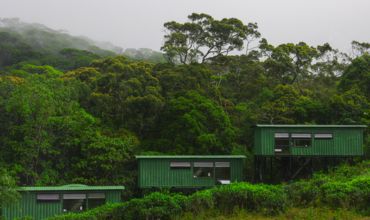
Managed by Aitken Spence Hotels, the hospitality division of Aitken Spence PLC, The Rainforest Ecolodge is embarking on a renewed journey that places the Sinharaja Forest Reserve, its rich biodiversity and surrounding communities at the centre of its guest experience. This fresh vision reinforces the property’s position as a gateway to one of Sri Lanka’s most valuable natural environments, combining responsible tourism, conservation and immersive nature experiences.
Located within the Enselwatte Tea Estate, bordering the Sinharaja Forest Reserve, the ecolodge enjoys an exceptional setting surrounded by remarkable natural beauty. It also holds LEED® Platinum certification from the US Green Building Council, highlighting its commitment to environmentally responsible design and construction. Recognised as both a UNESCO World Heritage Site and a Man and the Biosphere Reserve, Sinharaja represents Sri Lanka’s last remaining viable primary tropical rainforest and is home to an extraordinary range of endemic flora and fauna.
With its renewed direction, The Rainforest Ecolodge aims to become more than an accommodation option near the forest. It seeks to offer travellers meaningful opportunities to explore the rainforest, discover its ecological significance and develop a deeper appreciation of the natural world.
The property’s commitment to sustainability and responsible hospitality has earned international recognition. In 2026, it received the Silver Award in the ‘Nature Positive’ category at the ICRT Indian Subcontinent Awards for its contributions to biodiversity conservation, responsible nature-based tourism, community development and conservation education. The ecolodge was also recognised as Sri Lanka’s Leading Lodge 2026 at the World Travel Awards.
As Sri Lanka’s first officially classified ecolodge by the Sri Lanka Tourism Development Authority, the property has maintained sustainability as a fundamental principle since its inception. Its 20 chalets were constructed using repurposed shipping containers and other recycled materials, designed to blend with the surrounding tea estate and natural landscape. Each accommodation offers private decks, contemporary facilities and uninterrupted views, allowing guests to enjoy comfort while remaining closely connected to nature.
However, the most memorable experiences extend well beyond the accommodation.
The day begins with the sounds of rainforest birds, as guided birdwatching excursions introduce guests to mixed-species flocks and some of Sri Lanka’s endemic birdlife. Guided nature trails reveal the rainforest's diverse vegetation, medicinal plants and wildlife, while excursions to nearby waterfalls offer opportunities to explore forest pathways, streams and natural pools. After sunset, night walks provide a glimpse into the forest's nocturnal ecosystem, where frogs, moths, geckos, bats and other creatures become active.
Situated between dense rainforest and cultivated tea plantations, the ecolodge also provides a unique opportunity to observe the transition between different natural habitats and understand how wildlife interacts with these environments. This makes it an attractive destination for naturalists, wildlife photographers and citizen scientists.
Further strengthening its educational role, the property is developing a Nature Interpretation Centre and Online Knowledge Hub. These initiatives will bring together research publications, audiovisual resources, species information, conservation updates and field observations relating to Sinharaja. Designed for visitors, students, researchers, citizen scientists and nature enthusiasts, the platforms will make rainforest knowledge accessible before, during and after their visits.
The ecolodge also plans to establish partnerships with conservation organisations, universities, naturalists, wildlife photographers, artists, wellness practitioners and biodiversity specialists. Through these collaborations, it hopes to encourage citizen science, wildlife observation, acoustic monitoring, conservation storytelling and responsible rainforest exploration. The initiative will also create opportunities for specialists and citizen scientists to share knowledge and research findings with wider audiences.
Local communities remain an essential part of this vision. Employment opportunities, locally guided experiences, traditional knowledge, food heritage and rural livelihoods are all being incorporated into the guest experience. Activities and insights connected to kithul tapping, medicinal plants, tea cultivation and village traditions help visitors understand the relationship between the rainforest and the communities that have lived alongside it for generations.
This approach reflects the principles of regenerative tourism, where travel goes beyond minimising environmental impact to actively supporting the long-term wellbeing of local ecosystems and communities. Guests are encouraged to explore responsibly, contribute to local livelihoods and recognise the importance of protecting natural resources for future generations.
CNN’s Richard Quest touches down in Sri Lanka