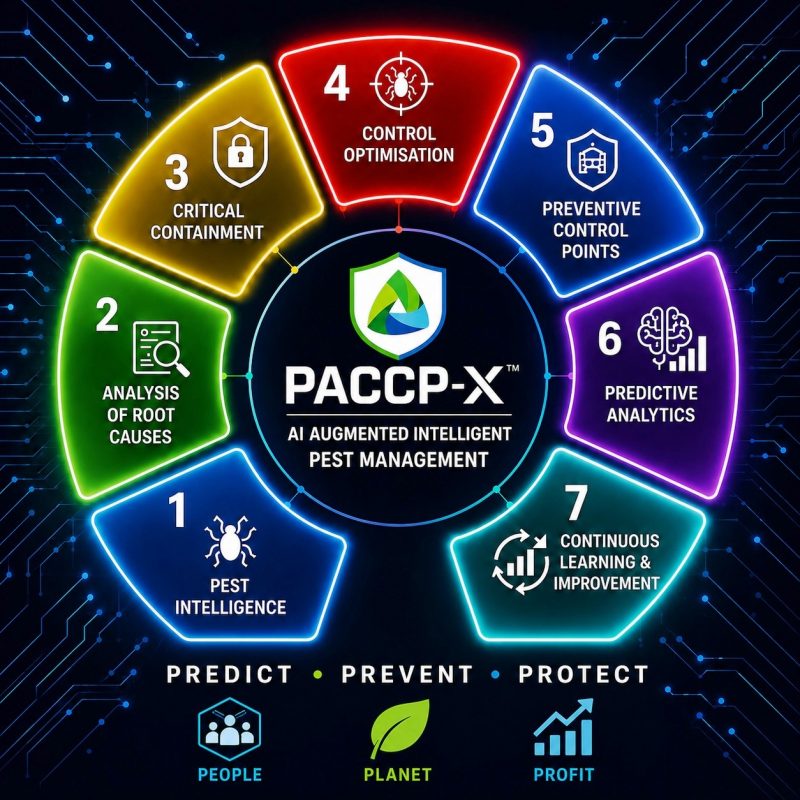





Exterminators PLC has announced the launch of PACCP-X™ (Pest Analysis Critical Control Points – X), an AI-augmented intelligent pest management framework designed to help organisations predict, prevent and protect against pest-related risks.
Developed by Denham Marlon Ferreira, Founder and Managing Director of Sentario UK Limited and Exterminators PLC, PACCP-X™ combines artificial intelligence, predictive analytics, smart monitoring and continuous learning with more than 34 years of pest management expertise.
The new framework aims to shift pest management away from a traditionally reactive service model towards a more intelligence-led and preventive approach, enabling organisations to identify risks earlier and implement targeted interventions before pest problems escalate.
Seven Core Elements of PACCP-X™
The PACCP-X™ framework integrates seven key components:
Pest Intelligence
Analysis of Root Causes
Critical Containment
Control Optimisation
Preventive Control Points
Predictive Analytics
Continuous Learning & Improvement
The framework has been designed for application across a broad range of industries, including food manufacturing, healthcare, hospitality, commercial property, local government, housing, agriculture and public health.
“Pest management has traditionally focused on responding after problems occur,” said Denham Marlon Ferreira, inventor of PACCP-X™. “PACCP-X™ changes that by combining scientific expertise with artificial intelligence to predict, prevent and continuously improve pest management outcomes.”
Built on Decades of Innovation
PACCP-X™ builds on the innovation legacy of Exterminators PLC, which was founded in Sri Lanka in 1998 and has developed a range of technologies and processes during its nearly three decades of operations.
The company has introduced innovations including digital field management, QR-enabled monitoring, AI-powered reporting and smart pest monitoring technologies. Through Sentario UK Limited, these capabilities are now being developed for international markets.
The framework also draws on Ferreira’s executive and professional education from leading international institutions, including Saïd Business School at the University of Oxford, where he studied Artificial Intelligence and Executive Leadership; Harvard Business School Online in Strategic Management, Innovation and Strategy Execution; the National University of Singapore in Strategic Marketing Management; and the Australian Institute of Business, where he completed an MBA.
His professional education also includes AIB International (USA) – Food Pest Management and AQIS Australia – Accredited Fumigator.
Ferreira holds internationally recognised professional qualifications including BASIS PROMPT (UK), BPCA (RSPH) Level 2 and NEA (Singapore) certification in mosquito management, alongside numerous qualifications covering pest, rodent and bird management, fumigation and food safety.
He also serves on the Entrepreneur Advisory Panel for the Australian Institute of Business and has received more than 34 entrepreneurship and innovation awards. He has additionally been named a finalist in the 2026 Great British Entrepreneur Awards and the 2026 Hertfordshire SME Business Awards in the global business and business leader categories.
Predict, Prevent and Protect
As part of the Sentario AI™ ecosystem, PACCP-X™ is built around three core principles:
Predict emerging pest risks
Prevent infestations through intelligent interventions
Protect people, businesses and the environment
The framework is also aligned with the principles of People, Planet and Profit, with potential applications in addressing major public health and environmental challenges such as dengue prevention, food safety, urbanisation and climate change.
Exterminators PLC and Sentario UK Limited have formed a strategic partnership to integrate artificial intelligence into pest management and develop solutions aimed at addressing critical public health and environmental challenges.
Through PACCP-X™, the companies are positioning intelligent pest management as a more proactive discipline—combining established scientific expertise with AI, predictive technologies and continuous learning to help organisations identify and manage pest risks before they become larger problems.
Scope Cinemas Sets New Benchmark with Sri Lanka’s Biggest-Ever Movie Premiere for Spider-Man: Brand New Day
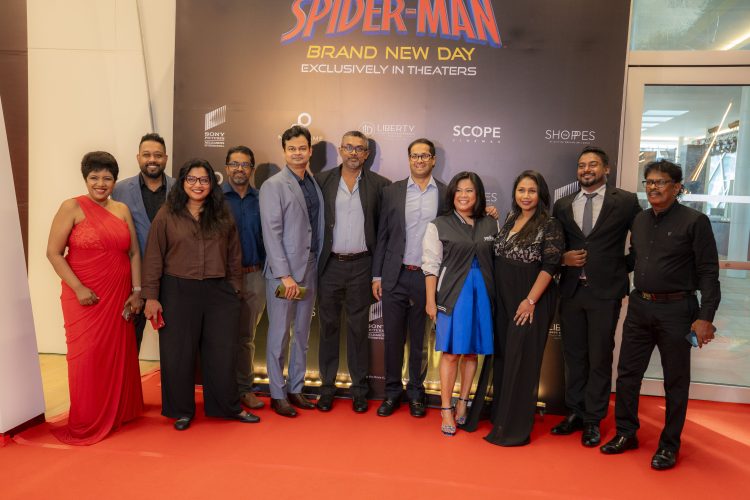
Scope Cinemas, in collaboration with Sony Pictures Releasing International, has raised the bar for Hollywood movie premieres in Sri Lanka with the launch of Spider-Man: Brand New Day, delivering what is believed to be the country’s biggest movie premiere to date.
The landmark launch featured an unprecedented series of fan experiences across the island, culminating in an exclusive red carpet premiere and Sri Lanka’s first-ever movie-themed drone show.
Held at The Shoppes at City of Dreams Sri Lanka, the premiere brought together invited media representatives and guests for an exclusive screening of the latest instalment in the Spider-Man franchise. The evening concluded with a spectacular drone show inspired by the iconic Marvel superhero, creating a memorable moment for Sri Lanka’s entertainment industry.
Spider-Man Takes Over Sri Lanka
In the lead-up to the premiere, Sony Pictures Releasing International, together with Liberty Lands & Developments and Next Frame Global, transformed the film's release into a nationwide celebration.
Fans in Jaffna, Kurunegala, Katugasthota, Kandy, Kegalle, Moratuwa, Gampaha, Wattala and Colombo had opportunities to meet Spider-Man, take part in interactive activities and receive official Spider-Man merchandise.
The celebrations also featured the Spidey Bus, which travelled through Colombo, bringing the Spider-Man experience directly to thousands of fans and building anticipation ahead of the film's premiere.
Commenting on the occasion, Naveed Cader, Chairman of Scope Cinemas (Pvt.) Ltd., said the company believes audiences deserve entertainment experiences comparable with those offered in leading global markets.
“At Scope Cinemas, we have always believed that audiences deserve experiences that rival those in the world's leading entertainment markets,” he said. “The premiere of Spider-Man: Brand New Day reflects our commitment to continually raising the standard of cinema exhibition in Sri Lanka by creating unforgettable experiences that extend well beyond the theatre.”
Chassy Cortes, Group General Manager – Marketing at Liberty Lands & Developments Pvt. Ltd, said the objective was to give Spider-Man fans an experience they had never experienced before in Sri Lanka.
The campaign took the character beyond the cinema through fan activities across multiple cities, the Spidey Bus, official merchandise and interactive experiences. It also introduced what the organisers described as Sri Lanka’s first movie-themed drone show and the company's first multi-location premiere.
Daniella Nobile, Chief Executive Officer of Next Frame Global, said the scale of the launch was designed to match the global appeal of the Spider-Man franchise.
She noted that the strong response from audiences demonstrated the growing demand for world-class theatrical events in Sri Lanka and highlighted the importance of creating experiences that extend beyond traditional cinema screenings.
A New Era for Movie Premieres in Sri Lanka
The Spider-Man: Brand New Day premiere forms part of Scope Cinemas’ continued investment in creating world-class theatrical experiences while introducing innovative ways to engage moviegoers.
Produced by Sony Pictures, Spider-Man: Brand New Day is the latest chapter in the globally popular Spider-Man franchise, bringing Peter Parker back to the big screen for a new adventure.
The film officially opened in cinemas across Sri Lanka on 30 July 2026, following the islandwide promotional campaign and landmark premiere event.
Exterminators PLC Launches PACCP-X™, an AI-Augmented Intelligent Pest Management Framework