




US semiconductor equipment maker Applied Materials will invest $5 billion in India over the next decade as it expands its presence in the country, the company announced on Thursday at SEMICON India, the country’s flagship semiconductor industry conference.
India’s growing semiconductor ambitions were on display at the three-day event in New Delhi, which brings together companies and industry representatives across chip materials, design, fabrication and packaging. The conference has attracted more than 600 companies and participants from 52 countries.
The event comes as the global semiconductor industry faces an intensifying race to expand chip production capacity, driven in large part by surging demand for computing power linked to artificial intelligence and increasingly complex geopolitical dynamics.
Amid reciprocal export restrictions on semiconductor technology imposed by the United States and China, India has positioned itself as a “trusted partner” for companies seeking to diversify their supply chains beyond Taiwan and China.
“The world stands in utmost need of new and reliable manufacturing locations. I say with great responsibility that India is continuously preparing itself for this,” Prime Minister Narendra Modi said.
According to Indian government estimates, the country’s semiconductor consumption could reach as much as $110 billion by 2030, compared with an estimated $45 billion to $50 billion in 2025.
Applied Materials, one of the world’s largest semiconductor equipment manufacturers, said its planned investment in India will focus on expanding research capabilities, scaling up its supply chain and developing the local workforce.
India has committed more than $21 billion through two major semiconductor incentive programmes as it seeks to establish a stronger position in the capital-intensive industry, which countries such as Taiwan have developed over several decades.
Twelve projects have been approved under India’s semiconductor incentive programme over the past five years, while three semiconductor packaging facilities, including a plant operated by US-based Micron Technology, have commenced commercial production.
However, India’s semiconductor drive has yet to produce a chip from a large-scale fabrication facility. Commercial production at the programme’s flagship project, a $10 billion semiconductor fabrication plant being developed by Tata Electronics in Gujarat, has been delayed by nearly two years.
Emirates Enters Winter Season with Strong Bookings and Expanded Network
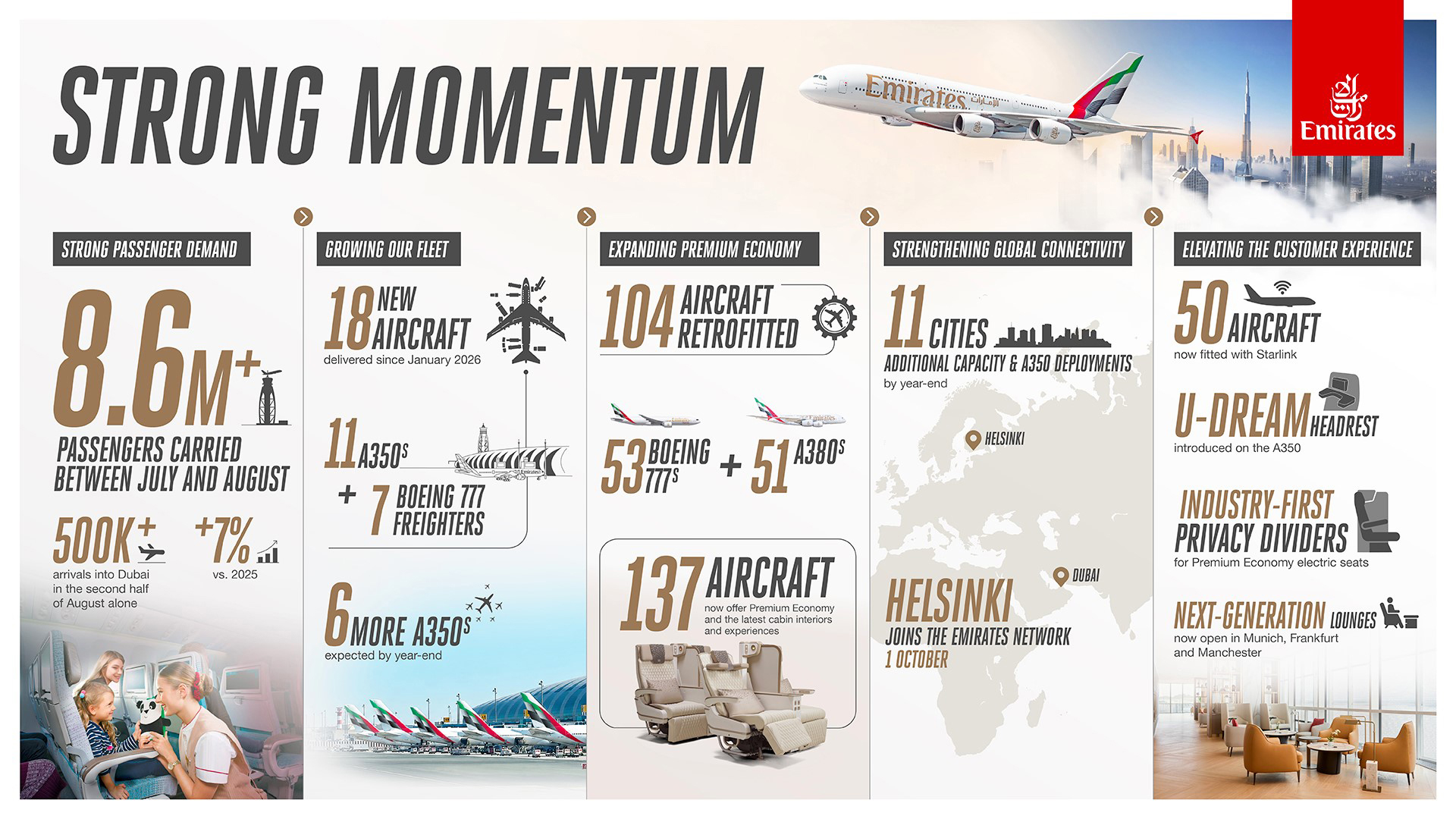
Emirates has concluded the summer season ahead of expectations and is entering the winter travel period with strong booking momentum across an expanding range of markets, as the airline continues to invest in its fleet, global network and industry-leading products while providing customers with greater booking flexibility and comprehensive travel coverage.
Between July and August, Emirates carried more than 8.6 million passengers while maintaining healthy seat load factors across its global network. The airline is currently operating at approximately 93% of its pre-disruption capacity, with demand continuing to strengthen ahead of the winter travel season.
Winter bookings, which begin in late October, are tracking positively despite a broader trend of travellers making their purchasing decisions closer to departure. Demand is currently ahead of the same period last year in markets including South Africa, Brazil, India, Portugal, Egypt, Ghana, Colombia, Saudi Arabia and Pakistan. Demand from Nepal is also showing positive momentum through Emirates’ partnership with flydubai.
The UAE continues to be a strong outbound market, while demand for premium travel on Emirates is also recording continued growth.
Strong Summer Demand
Emirates services to and from West Asia, Europe, the Middle East, the Americas and Africa recorded seat load factors above 75% during the summer, with particularly strong demand on routes serving Indonesia, Côte d’Ivoire and destinations across the UK.
Demand for Emirates’ Premium Economy cabin also increased across the network, with the Americas recording the strongest growth in demand for the premium cabin.
Dubai continued to attract strong inbound passenger traffic during the summer. In late August alone, more than 500,000 customers arrived in Dubai on Emirates flights, representing a 7% increase compared with the same period last year.
Passengers included UAE residents returning ahead of the new school year, new residents relocating to Dubai for work and residence, as well as international visitors choosing Dubai for a late-summer getaway.
The continued strength of passenger demand reflects the airline’s expanding network and ongoing investments in its fleet, products and customer experience as Emirates prepares for the winter travel season.
Applied Materials Announces $5 Billion Investment in India as Semiconductor Summit Begins