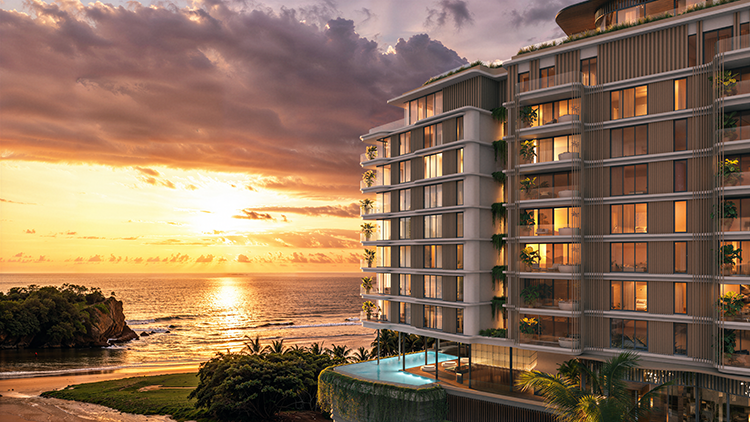





Crystal Property Group (CPG) has officially launched MIRA Weligama, an exclusive ultra-luxury branded residential development overlooking the pristine coastline of Sri Lanka’s south. Featuring just 44 private residences, the project is set to redefine high-end coastal living while establishing a new benchmark for luxury real estate investment in the country.
Developed as a joint venture with Savi Residencies Pvt Ltd and designed by PWA Architects, the eight-storey development combines contemporary architecture, exceptional craftsmanship and world-class hospitality. Every residence is delivered fully furnished and move-in ready, enabling homeowners to immediately enjoy their property or generate rental income from the day of handover.
Each residence also features a spacious private terrace complete with a plunge jacuzzi overlooking the Indian Ocean, offering residents an exclusive blend of comfort, privacy and panoramic ocean views.
MIRA Weligama will be branded and professionally managed by The One Group of Hotels, building on the success of The Six Weligama, one of Sri Lanka’s most renowned luxury hospitality destinations. The development introduces a new level of personalized service, premium amenities and owner-focused experiences to the country's branded residence market.
Every residence spans approximately 1,200 square feet and offers a thoughtfully planned 1.5-bedroom, two-bathroom layout complemented by soaring 3.6-metre ceilings—among the tallest available in Sri Lanka’s luxury residential sector. The spacious interiors are designed to maximize natural light while creating a seamless connection with the surrounding coastal landscape.
“Our vision was built around two key objectives,” said Reza Magdon Ismail, Founder and CEO of Crystal Property Group. “The first was to create a branded residence that delivers uncompromising luxury through exceptional design, generous living spaces and world-class hospitality. The second was to provide owners with an investment capable of delivering strong and consistent long-term returns. Our all-suite concept reflects the travel preferences of today’s luxury guests while enabling premium average daily rates of approximately US$500, creating significant value for our owners.”
A standout feature of MIRA Weligama is its dedicated lifestyle and wellness floor, designed exclusively for residents and their guests. Overlooking the Indian Ocean, the level offers an extensive collection of luxury amenities, including a signature beach club, destination dining venues, a vinyl listening lounge, an intimate cocktail bar, a fully equipped fitness centre and a dedicated Pilates studio.
3Rive Technologies Joins the Anthropic Claude Partner Network as an Official Partner

3Rive Technologies, an AI-first legal technology service provider, has announced its official admission into Anthropic’s Claude Partner Network, joining a global ecosystem of trusted firms trained and accredited to deploy Claude, Anthropic’s family of advanced AI models, within client organisations.
Headquartered in Australia, with its engineering and AI development centre in Sri Lanka, a regional office in Dubai and plans to establish a presence in the United Kingdom, 3Rive Technologies provides AI-powered legal technology solutions to law firms and legal businesses across the UK and Australian markets. The company believes it is among the world’s first legal technology-focused service providers to become part of Anthropic’s prestigious partner network.
“We set out to build something different—a legal technology company that is AI-first from the ground up rather than one simply adding AI to traditional service models,” said Chuck Silva, Founder and Chief Executive Officer of 3Rive Technologies. “Our ambition is to become the leading legal technology service provider across the Asia-Pacific region and, ultimately, one of the largest globally. This partnership is a significant milestone towards that goal. More importantly, we want to transform how technology is delivered and inspire engineers and technology professionals to adopt an AI-first mindset. The organisations that embrace this shift today will shape the future of legal services.”
AI-First Innovation at the Core
At the heart of 3Rive’s approach is Cognitive Outsourcing™, a UK trademarked gain-share managed services model that enables the company to assume operational responsibility for a client’s back-office functions while funding AI-driven transformation over a multi-year engagement. Under the model, clients retain ownership of the AI assets created, ensuring long-term value from their digital transformation investments.
The AI-first philosophy extends beyond customer solutions into 3Rive’s own operations. Claude has been integrated across the company’s engineering, software development, marketing, delivery and back-office functions, allowing the firm to operate in the same way it advises its clients to embrace AI.
Supporting Sri Lanka’s AI Ecosystem
In addition to delivering AI solutions for clients, 3Rive Technologies plans to strengthen Sri Lanka’s growing AI community by expanding knowledge-sharing initiatives through its Colombo-based engineering and AI development centre.
The company intends to host a series of public Claude-focused events, including workshops, live demonstrations and community meetups, while also applying to join Anthropic’s Claude Community Ambassadors programme to help foster a stronger local ecosystem of AI developers and builders.
“If we want to create the next generation of AI-first engineers, someone has to lead by example and share practical knowledge,” Silva added. “We want to be that company and help position Sri Lanka as a recognised destination for world-class AI engineering talent.”
By joining the Claude Partner Network, 3Rive Technologies strengthens its position as a leader in AI-powered legal technology while reinforcing its commitment to driving innovation, advancing AI adoption and nurturing technical talent across the region.
CPG Launches MIRA Weligama, Setting a New Standard for Ultra-Luxury Branded Residences in Sri Lanka