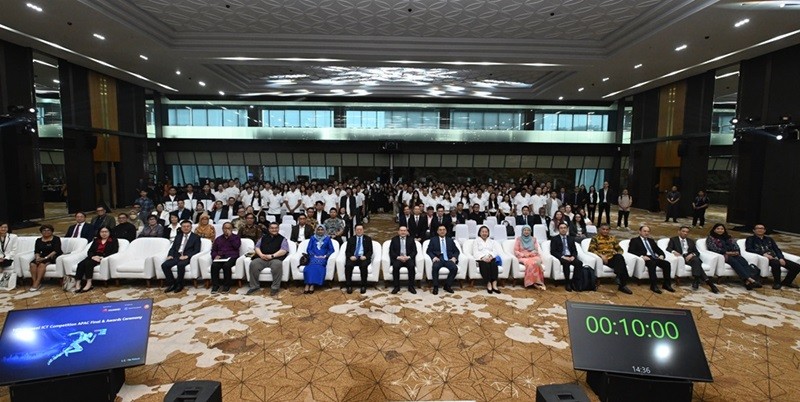





The 10th Huawei ICT Competition APAC Finals and Awards Ceremony was held at the ASEAN Headquarters in Jakarta, Indonesia, bringing together students, educators, government officials, and ICT industry stakeholders from across the Asia-Pacific region.
Organised by Huawei in partnership with the ASEAN Foundation, the competition attracted more than 8,600 students from 14 countries and regions. More than 160 finalists from 13 countries advanced to the regional finals, competing across cloud, computing, network, and innovation categories.
The event was attended by ASEAN Secretary-General Kao Kim Hourn, Indonesian government officials, ASEAN Foundation representatives, and regional ICT leaders.
Addressing the ceremony, Dr. Kao Kim Hourn highlighted the importance of developing digital talent to support the region’s digital transformation goals under the ASEAN Digital Masterplan 2030.
Among the top winners, the National University of Singapore secured the Grand Prize in the Innovation Competition, while teams from the Vietnam Posts and Telecommunications Institute of Technology claimed top honours in the Computing and Cloud tracks. Bulacan State University won the Network Track.
Teams representing Malaysia, Indonesia, Thailand, Brunei, Japan, Laos, Timor-Leste, Hong Kong SAR, and Macao SAR also received awards across various categories. Sixteen regional teams have now qualified for the global finals scheduled to be held in Shenzhen, China, this June.
During the event, Huawei Asia Pacific announced several new initiatives focused on AI talent development and digital skills training. The company also launched its overseas white paper titled ICT Job Roles and Skills in the Intelligent World, developed in collaboration with IDC, OpenAtom Foundation, and the Global Intelligent Internet of Things Consortium.
The report explores emerging ICT employment trends, evolving industry skill requirements, and training pathways related to artificial intelligence and intelligent technologies. Huawei also revealed updates to its ICT Academy curriculum, introducing new AI-focused courses for universities and training institutions.
Representatives from Huawei, the ASEAN Foundation, and the International Telecommunication Union (ITU) additionally announced a regional collaboration initiative aimed at strengthening AI talent development, youth empowerment, and digital inclusion across Asia-Pacific.
According to Huawei, its ICT Academy programme in the Asia-Pacific region has expanded significantly over the past nine years, growing from two institutions in two countries to more than 500 institutions across 18 countries and regions, training over 160,000 students.
Pan Asia Bank records highest-ever quarterly deposits and advances growth in Q1 2026

Pan Asia Banking Corporation delivered a strong financial performance in the first quarter of 2026, recording its highest-ever quarterly growth in both loans and customer deposits despite ongoing global economic uncertainty and geopolitical tensions in the Middle East.
The Bank reported a Profit Before Tax (PBT) of Rs 1.65 billion and a Profit After Tax (PAT) of Rs 1.05 billion for the quarter, reflecting disciplined financial management, operational stability, and prudent risk controls.
Net Interest Income increased by 12% year-on-year, supported by higher lending volumes within a relatively stable to moderately easing interest rate environment. Interest income rose by 18%, while interest expenses increased by 23% during the period.
Non-interest income also showed strong momentum, with net fee and commission income growing by 55%, while net trading gains rose by over 40%, driven by improved returns from unit trusts and government securities classified at fair value through profit or loss (FVPL). Overall, total operating income increased by 14% compared to Q1 2025.
The Bank also reported a significant improvement in impairment performance, with credit loss expenses declining by 93% year-on-year, largely due to net reversals in Stage 3 impairments. Stage 1 and Stage 2 impairment charges increased in line with loan book expansion and updated forward-looking risk assessments, while a net Stage 3 impairment reversal of Rs 125.3 million was recorded.
Asset quality remained strong, with the Stage 3 loan ratio maintained at 1.57% — among the lowest in the banking industry — while the Stage 3 Provision Coverage Ratio stood at 62.21%.
Net Operating Income rose by 17% year-on-year, although the cost-to-income ratio increased slightly due to a high comparative base resulting from one-off reversals recognised in the previous year.
The Bank’s advances portfolio expanded by 10% to Rs 239.49 billion, marking the strongest quarterly loan growth in its history. Customer deposits also increased by 10% to Rs 254.19 billion, representing the Bank’s highest-ever quarterly deposit growth.
Total assets grew by 9% to Rs 334.61 billion, while capital and liquidity positions remained well above regulatory requirements. The Common Equity Tier 1 Ratio and Tier 1 Ratio stood at 14.86%, with the Total Capital Ratio at 16.43%. Liquidity Coverage Ratios remained robust at 192.98% for rupee liquidity and 151.72% for all currencies, while the Net Stable Funding Ratio stood at 126.92%.
Commenting on the performance, Chairman Aravinda Perera stated that the Bank has entered 2026 on a strong footing, delivering steady earnings growth alongside record expansion in loans and deposits.
Winners of 10th Huawei ICT Competition APAC crowned at ASEAN Headquarters