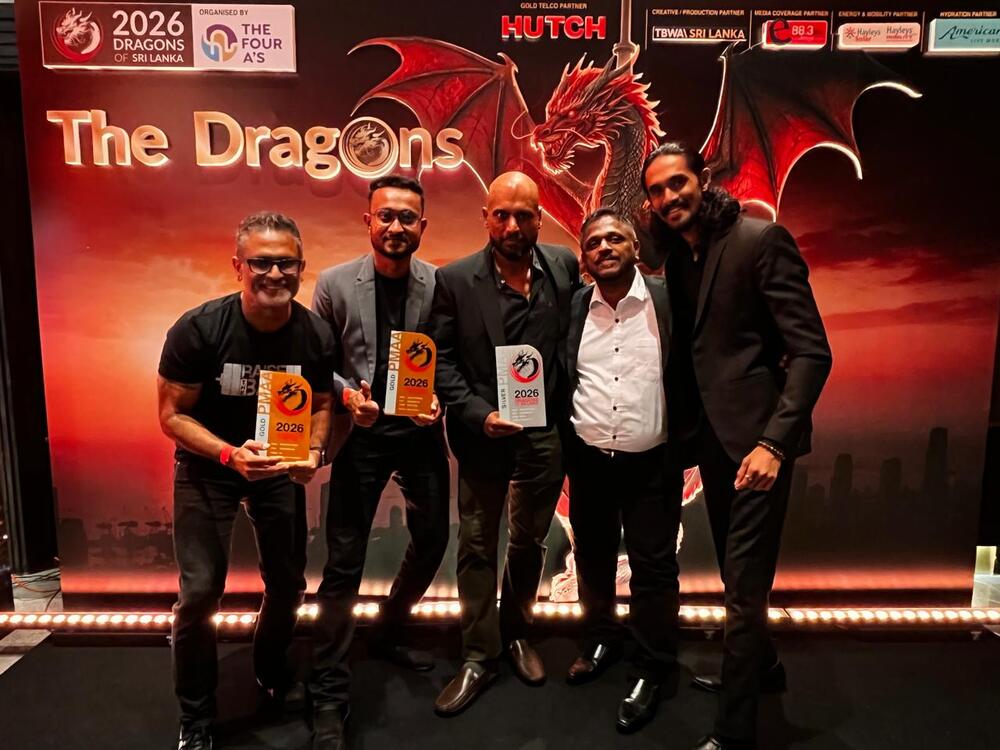





Ogilvy Group Sri Lanka delivered an impressive performance at the recently concluded Dragons of Sri Lanka 2026 Awards, securing nine accolades comprising two Gold Dragons, one Silver Dragon and six Black Dragons, placing the group among the event’s leading award winners.
Gold Dragon wins for Phoenix Ogilvy and Ogilvy Digital, alongside seven additional recognitions across multiple categories, highlighted the group’s ability to combine creativity, strategic thinking and commercial effectiveness to deliver measurable business results.
Organised by 4As Sri Lanka, the third edition of the Dragons of Sri Lanka Awards shortlisted entries from more than 50 agencies and corporate organisations, making it one of the country’s competitive marketing communications award programmes.
The local awards, together with the Malaysia and Pakistan editions, form part of the Dragons of Asia platform, a regional programme recognising marketing communications effectiveness. Entries are evaluated on strategy, originality, execution and measurable results.
Ogilvy Digital secured eight awards, including a Gold Dragon in the Business & Trade Marketing category and a Silver Dragon in the Innovative Idea or Concept category. The agency also received six Black Dragons across the Innovative Idea or Concept, Business & Trade Marketing, Content Creation, Small Budget, Event or Experiential, and Brand Trial or Sales Generation categories.
Commenting on the achievement, Sajith Weerasinghe, Chief Operating Officer of Ogilvy Digital, said, “These recognitions reflect the breadth of capabilities we’ve built across strategy, creative, content, experience design, technology and performance marketing. The fact that the work was recognised across so many different disciplines demonstrates our ability to apply creativity to a wide range of business challenges and objectives. We’re proud that this achievement spans multiple clients, categories and types of work, reflecting both the versatility of our people and our commitment to delivering results.”
The group’s second Gold Dragon was awarded to Phoenix Ogilvy in the Product Launch or Re-Launch category for its campaign relaunching American Premium Water.
The multi-dimensional campaign refreshed the brand’s identity and repositioned one of Sri Lanka’s pioneering bottled drinking water brands. It sought to build on the brand’s 30-year heritage while strengthening its appeal to a new generation of consumers.
DEFY Launches DEFY INT and Appoints Wasaam Ismail as CEO

DEFY has announced the launch of DEFY INT, its new through-the-line (TTL) agency, with Wasaam Ismail appointed as Chief Executive Officer.
Designed for brands seeking a cohesive presence across every touchpoint, DEFY INT places digital at the centre of its offering. The agency brings together creative conceptualisation, integrated campaigns, audio-visual and film production, live brand experiences, and data-driven execution, using artificial intelligence (AI) where it adds meaningful value.
The agency is built around five pillars reflected in its name: Interactive, Intelligent, Integrated, Intentional and Defyint.
Interactive describes the agency’s approach to creating engaging experiences across creative, digital, audio-visual and live platforms. Intelligent reflects its use of data, analytics, audience targeting and AI. Integrated brings creative thinking and a comprehensive range of services together under one team and a unified brand narrative. Intentional represents its selective approach to client partnerships and the commitment it brings to each relationship. Defyint embodies the agency’s belief that challenging conventional thinking can lead to better outcomes.
Wasaam Ismail Appointed CEO
Ismail brings extensive experience in advertising, marketing and corporate communications to his new role. He spent nine years at Loops Integrated, initially joining as General Manager before serving as CEO for more than half of his tenure. During this period, he played a significant role in mentoring the first—and, to date, only—Sri Lankan team to win the Young Spikes competition in the Digital category.
More than half of Ismail’s career has been spent in advertising, with previous experience at agencies including Phoenix Ogilvy and Z Messenger. He has also worked at Hutchison Telecommunications and served as General Manager – Head of Corporate Communications and Marketing at LAUGFS Holdings.
Throughout his career, Ismail has worked across several sectors, including finance, fast-moving consumer goods (FMCG), retail, telecommunications, energy, fashion and hospitality. His work has received recognition at the Effie Awards, SLIM Digis and Dragons of Asia.
Beyond his corporate roles, Ismail has contributed to the development of Sri Lanka’s advertising and digital marketing industries. He has served on the board of the Accredited Advertising Agencies Association (4A’s) and is currently an Executive Committee Member of the Digital Marketing Association of Sri Lanka (DMASL).
His industry involvement also includes serving as a jury member for the Effie Awards, Deputy Jury Head for SLIM Digis and a judge at the local Young Spikes Asia competition.
Ismail also spent nine years lecturing for the Chartered Institute of Marketing (CIM) at the Sri Lanka Institute of Marketing, contributing to the development of future marketing professionals.
He holds an MBA (Australia) and a Postgraduate Diploma in Marketing from CIM UK. He is also a recipient of the Sri Lanka Prize for Marketing Planning from CIM UK.
Ogilvy Group Sri Lanka Leads Award Tally at Dragons of Sri Lanka 2026