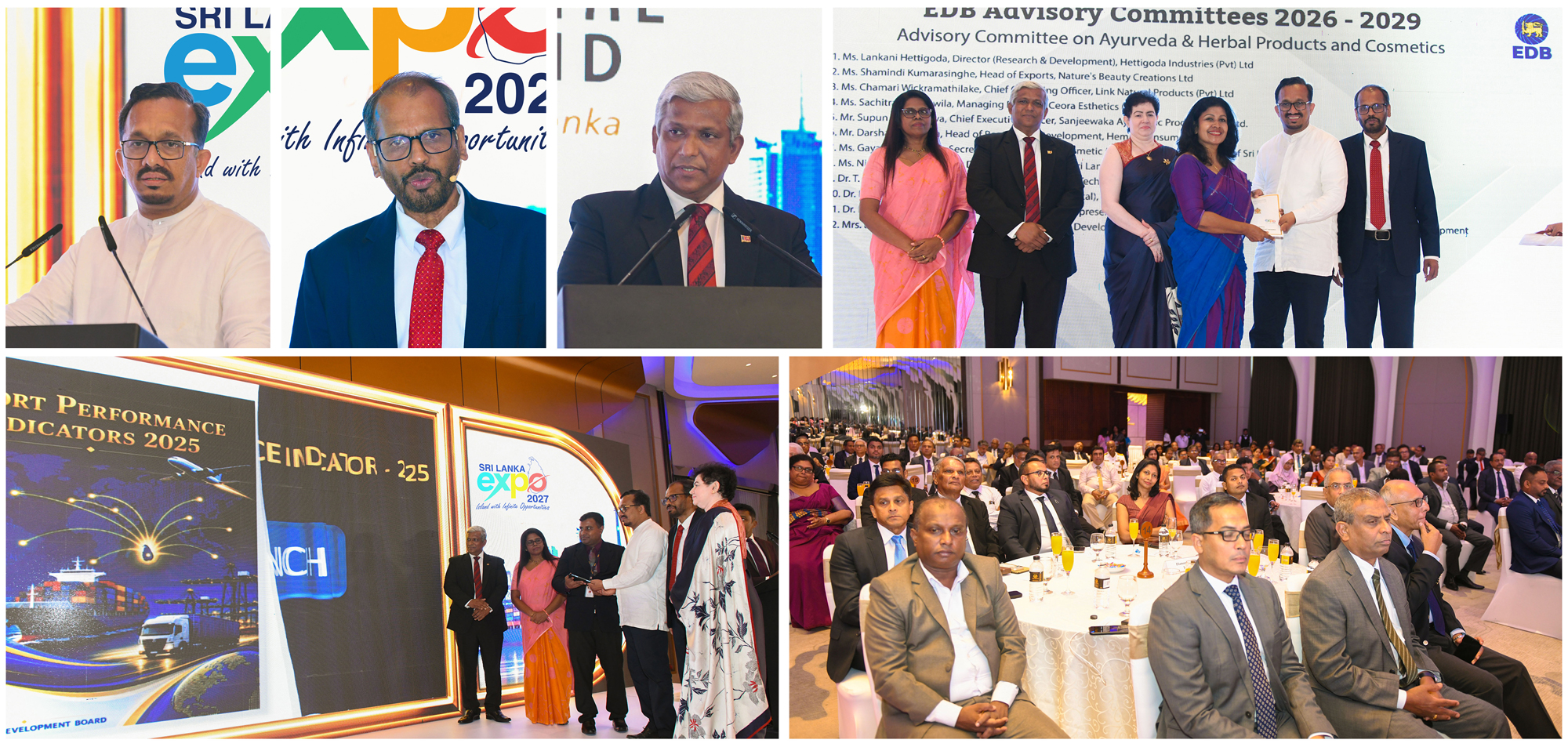





The Sri Lanka Export Development Board (EDB) presented appointment letters to members of its Advisory Committees for the 2026–2029 period and launched the Export Performance Indicators 2025 at a ceremony held at The Grand Maitland, Maitland Place, Colombo 07. The event was attended by Minister of Industry and Entrepreneurship Development Sunil Handunnetti as the chief guest.
Addressing the gathering, Minister Sunil Handunnetti said, “Building on the growth achieved by all export sectors over the past two years, we must move towards new targets that surpass our own past records. By amending outdated laws and regulations that hinder exports, and with the collective strength and technical expertise of the public and private sectors, everyone must join hands to achieve these export targets.”
EDB Chairman and Chief Executive Officer Mangala Wijesinghe briefed the newly appointed Advisory Committee members on the National Export Development Plan (NEDP) 2026–2030. He also provided a special briefing on Sri Lanka Expo 2027, the upcoming international exhibition.
The event was attended by Secretary to the Ministry of Industry and Entrepreneurship Development Thilaka Jayasundara, EDB Chairman and Chief Executive Officer Mangala Wijesinghe, Director General Erandika Dissanayake, Additional Director General (Development) Kumuduni Mudalige, other officials and members of the Advisory Committees.
Under Section 10(1) of the Sri Lanka Export Development Act No. 40 of 1979, the EDB is empowered to establish Advisory Committees to support the development and promotion of products and services, as well as various functional aspects of export trade. Accordingly, new members have been appointed to serve on the committees for a three-year term from 2026 to 2029.
The committees comprise representatives from exporting businesses, small and medium-sized enterprises (SMEs), private sector associations, relevant government institutions and sector specialists. Members were selected based on their experience and the contributions they could make to the development of their respective sectors.
The Advisory Committees play an important role in the EDB’s work, providing insights and recommendations that contribute to the formulation of annual action plans, the National Export Development Plan and the National Export Policy. Their expertise is expected to support efforts to revitalise export performance and place the sector on a sustainable growth trajectory.
With Sri Lanka targeting US$36 billion in exports by 2030 and seeking to diversify its export product portfolio, the Ministry of Industry and Entrepreneurship Development, in collaboration with the EDB and key public and private sector stakeholders, formulated the NEDP. The plan was developed with technical assistance from the Asian Development Bank (ADB) under the Ministry’s policy-based lending programme and identifies strategies to strengthen the national business environment and accelerate export growth.
The 24 newly established Advisory Committees cover cross-sector enablers, priority export sectors and other key industries.
Cross-sector enablers
Six committees focus on areas identified as essential to achieving the NEDP’s objectives:
Trade Logistics and Hub Operations
Trade Facilitation
Trade Finance, Business and Investment Environment Reform
Trade Promotion and Market Links
Quality Management, Standards, and Environmental, Social and Governance (ESG)
Skills Development, Entrepreneurship and Innovation
NEDP priority sectors
Eight committees represent the plan’s priority sectors:
Auto Components and Engineering
Mineral-based Products
Rubber-based Industries
Marine-based Industries, including Boat and Shipbuilding
Spices and Concentrates
Digital Products and Services
Electrical and Electronic Components
Processed Food and Beverages
Other key sectors
The remaining ten committees cover:
Apparel
Ayurveda, Herbal Products and Cosmetics
Coconut and Coconut-based Products
Construction and Power Energy Services
Gems, Diamonds and Jewellery
Organic Products
Ornamental Fish
Pharmaceuticals
Seafood and Aquaculture
SME Exports Development
Through the appointment of these committees and the launch of the Export Performance Indicators 2025, the EDB aims to strengthen stakeholder collaboration and support the implementation of national strategies to expand Sri Lanka’s exports and achieve its 2030 export target.
CSE and Commercial Bank Join Forces to Drive Growth Among Sri Lankan Enterprises

The Colombo Stock Exchange (CSE) and Commercial Bank of Ceylon PLC have signed a Memorandum of Understanding (MoU) to promote enterprise development, facilitate capital formation and strengthen collaboration across several strategic areas.
The agreement reflects both institutions’ recognition of the opportunities to expand access to capital markets by supporting small and medium-sized enterprises (SMEs) and the wider corporate growth ecosystem. It also underscores their shared commitment to improving financial literacy and engagement.
Through this partnership, the CSE and Commercial Bank aim to make capital markets more accessible to SMEs. Greater participation by these businesses is expected to deepen the market, broaden investment opportunities and contribute to long-term economic growth.
Under the agreement, the two institutions will establish a structured process to identify and onboard eligible businesses for listing. The collaboration will draw on Commercial Bank’s extensive customer network and the CSE’s platforms to identify promising companies and provide them with appropriate support.
The partnership will also facilitate workshops and seminars, promote financial literacy, and guide potential issuers on capital-raising opportunities and regulatory requirements.
Commercial Bank’s Investment Banking Unit will support participating companies by providing guidance on capital-raising options, regulatory obligations and readiness assessments for prospective issuers.
The MoU also establishes a foundation for joint engagement initiatives, including workshops, seminars and individual advisory sessions. These activities will help the CSE extend its reach beyond traditional market segments, engage businesses in underserved regions and sectors, and promote greater inclusivity and diversity within Sri Lanka’s capital market.
Beyond facilitating individual listings, the partnership reflects a broader commitment to strengthening the country’s financial ecosystem. By combining their expertise and extensive networks, the CSE and Commercial Bank aim to create clearer pathways for business growth, encourage informed investment decisions and expand access to opportunities for enterprises across Sri Lanka.
EDB Appoints 24 Advisory Committees for 2026–2029 and Launches 2025 Export Performance Indicators