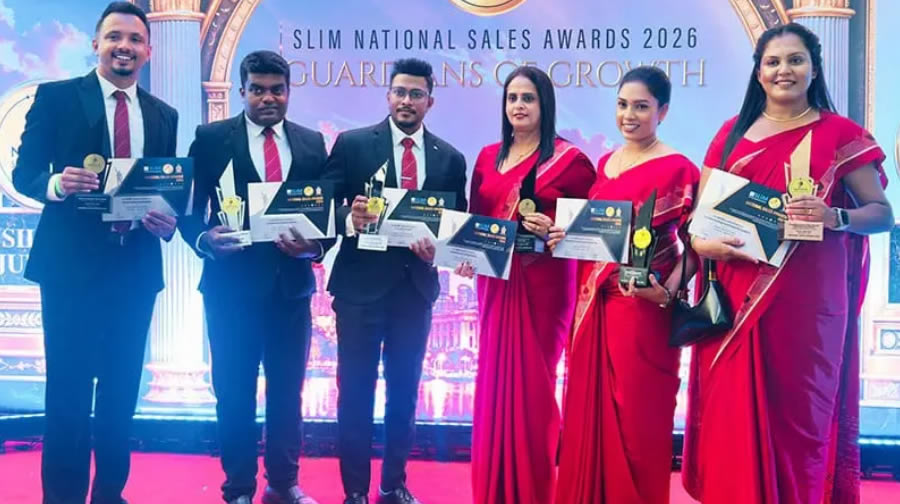





Six sales professionals from Ceylinco Life, Sri Lanka’s life insurance market leader, have received national recognition for their outstanding sales performance, securing six awards at the 2026 National Sales Awards organised by the Sri Lanka Institute of Marketing (SLIM).
The recognition spans three award categories, with the winning professionals representing Ceylinco Life branches in Wennappuwa, Middeniya, Negombo and Nugegoda, as well as its Colombo Special Sales Branch.
In the Territory Manager category, Lasitha Fernando of the Wennappuwa branch secured a Silver award. In the Sales Executive category, J.A. Rathnasiri of the Middeniya branch received Silver, while K. D. L. N. Inoka of the Negombo branch was recognised with a Merit award.
The Frontliner category saw Rashmi Suraweera of the Negombo branch win Bronze. Kumuduni Rathnayaka of the Nugegoda branch and Sherman Rukshan of the Colombo Special Sales Branch also received Merit awards in the same category.
The SLIM National Sales Awards celebrate exceptional sales performance and recognise professionals who demonstrate excellence and make significant contributions to their organisations. The 2026 edition featured participants from 20 industry categories, with awards presented across nine designations covering frontline sales, sales management and sales support functions.
Winners are selected through a rigorous assessment process, with nominees evaluated against established performance criteria. Gold, Silver, Bronze and Merit awards are presented based on the scores achieved, ensuring that recognition reflects measurable accomplishments and professional excellence.
Ceylinco Life has maintained a strong presence at the SLIM National Sales Awards, formerly known as the National Sales Congress (NASCO) Awards, since 2011. Over the years, employees representing its extensive islandwide branch network have achieved recognition across multiple categories, highlighting the Company’s continued investment in developing a skilled, high-performing sales force.
SLIIT’s SICET 2026 Encourages Industry Partnerships to Drive Engineering Innovation and Sustainability

The Faculty of Engineering at the Sri Lanka Institute of Information Technology (SLIIT) has successfully concluded the fifth edition of the SLIIT International Conference on Engineering and Technology (SICET) 2026, held under the theme “Engineering Resilience through Sustainable and Smart Solutions”. Conducted from 1 to 4 September, the four-day conference brought together researchers, academics, industry experts and student innovators to exchange knowledge, present research and explore innovative approaches to real-world challenges in engineering, technology and applied sciences.
Chaired by Prof. Shiromi Karunaratne, SICET 2026 featured a series of expert-led workshops and technical sessions addressing emerging developments across multiple disciplines. Key areas included artificial intelligence, computer vision, robotics, smart manufacturing, biomedical engineering, communications, renewable energy, sustainable infrastructure and agricultural monitoring.
A major focus of this year's conference was strengthening collaboration between academia and industry. The newly enhanced Industry Connect Track provided a platform for industry professionals, academics, researchers and students to exchange insights and explore opportunities for collaboration. The conference also introduced a School Connect Track for the first time, enabling school students to engage with engineering and technology while presenting their innovative projects and ideas.
One of the key highlights was the keynote address by Deshamanya Prof. Mohan Munasinghe, who contributed to the work of the United Nations Intergovernmental Panel on Climate Change (IPCC), a recipient of the Nobel Peace Prize. His address examined the role of engineering and technological advancement in creating a sustainable, inclusive and equitable future.
“The true measure of engineering progress is how it improves lives, reduces inequality, and protects the planet for future generations. Economic prosperity, social equity, and environmental responsibility must advance together. As artificial intelligence and other disruptive technologies reshape our world, engineers must take leadership roles, think across disciplines, and act with a social conscience. Human oversight, transparency, and high ethical standards are essential to ensuring that innovation serves the wider public good,” Prof. Munasinghe stated.
The event was also attended by Mr. M. L. Gammampila, Acting Secretary to the Ministry of Science and Technology, as the Chief Guest, while Eng. Kosala Kamburadeniya, President of the Institution of Engineers Sri Lanka (IESL), participated as the Guest of Honour.
Ceylinco Life Sales Professionals Secure Six Awards at SLIM National Sales Awards 2026