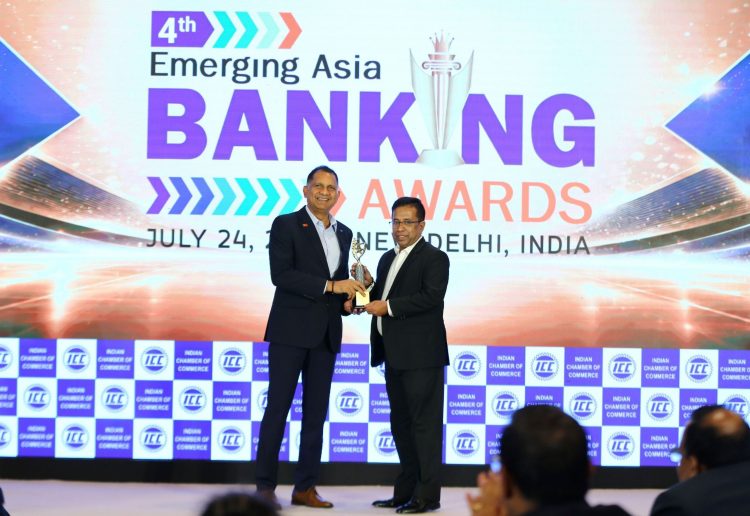





DFCC Bank has received two prestigious country-level awards at the 4th ICC Emerging Asia Banking Conclave & Awards 2026, winning Best Performance on Growth – Sri Lanka and Best Performance on Profitability – Sri Lanka.
Organised by the Indian Chamber of Commerce (ICC), the regional awards recognise the performance and achievements of financial institutions across emerging markets in Asia.
The awards were presented to Anton Arumugam, Senior Vice President – Offshore Banking, Remittances and Business Development at DFCC Bank, by K. G. P. Sirikumara, Deputy Governor of the Central Bank of Sri Lanka, at a ceremony held in New Delhi, India.
The dual recognition highlights DFCC Bank’s ability to expand its business while strengthening financial returns. It reflects the Bank’s disciplined approach to growth, including deepening customer relationships, maintaining prudent balance sheet management and investing in capabilities that support long-term performance.
Commenting on the recognition, Thimal Perera, Director and Chief Executive Officer of DFCC Bank, said:
“Growth matters when it strengthens the business and creates the capacity to serve customers better. Profitability matters because it allows us to continue investing in our people, technology and customer experience. Being recognised in both areas is therefore significant. It reflects the discipline with which our teams have pursued growth, managed risk and converted opportunity into stronger performance. Our responsibility now is to build on that progress with the same focus.”
The recognition comes as DFCC Bank continues to expand its business while maintaining a strong focus on financial discipline, operational resilience and sustainable returns. The awards underscore the Bank’s continued efforts to balance business growth with sound risk management and long-term value creation.
ComBank Group Deposits Surpass Rs. 3 Trillion in Strong Six-Month Performance

The Commercial Bank of Ceylon Group has strengthened its position as a leading financial intermediary, becoming the first private sector banking group in Sri Lanka to surpass Rs. 3 trillion in deposits during the second quarter of the 2026 financial year.
The Group’s deposits increased by Rs. 315.13 billion during the six months ended 30 June 2026, averaging Rs. 52.52 billion in monthly growth, to reach Rs. 3.02 trillion by the end of the first half. Over the preceding 12 months, deposits grew by a notable 20.33%, representing an average monthly increase of Rs. 42.46 billion.
During the six-month period under review, the Group’s gross loans and advances increased by Rs. 270.43 billion, or an average of Rs. 45.07 billion per month, taking the total loan portfolio to Rs. 2.36 trillion. Over the preceding 12 months, lending expanded by Rs. 624.48 billion, equivalent to 36.07% growth, at a monthly average of Rs. 52.04 billion.
According to interim financial statements filed with the Colombo Stock Exchange (CSE), the Group’s total assets increased by 10.68%, or Rs. 361 billion, from December 2025 to reach Rs. 3.74 trillion as at 30 June 2026. This represents a substantial 19.42%, or Rs. 608.16 billion, increase over the preceding 12 months.
Commenting on the performance, Commercial Bank Chairman Sharhan Muhseen said the resilience of the Group’s core banking operations provides confidence amid continuing global and regional challenges.
“As the impacts of global and regional developments continue to take their toll on businesses and economies, our stakeholders can draw confidence from the resilience underscored by the enduring strength of our core banking operations,” he said. “We continue to refine our projections and strategic responses to the evolving challenges while remaining firmly anchored to our strategic vision and steadfast in our commitment to delivering lasting value to our customers, stakeholders and the wider community we serve.”
Commercial Bank Managing Director and CEO Sanath Manatunge said the Group’s six-month results demonstrate the value of maintaining adequate financial buffers to manage external pressures.
DFCC Bank Honoured for Growth and Profitability at ICC Emerging Asia Banking Awards 2026