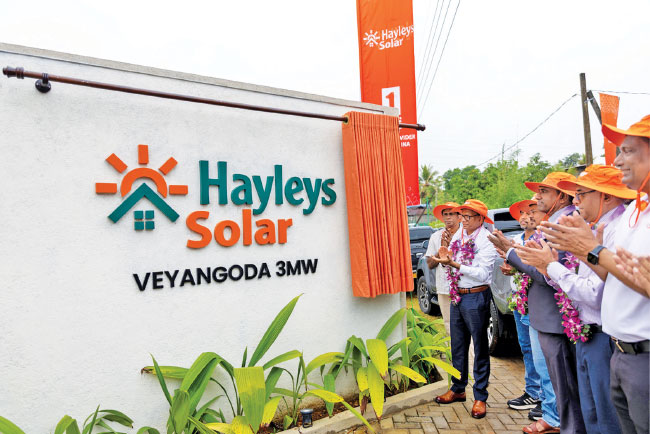
Hayleys Solar, a leading renewable energy solutions provider in Sri Lanka, has commissioned its 3MW Veyangoda Ground-Mounted Solar Project, marking a significant step in the company’s expansion of large-scale renewable energy generation.
The project was officially inaugurated in the presence of Anura Karunathilake, Minister of Energy, and represents the first project under Hayleys Solar’s planned 300MW portfolio of ground-mounted solar power projects across Sri Lanka.
Hayleys Solar is part of Hayleys Fentons Limited, a member of Hayleys Group, one of Sri Lanka’s most diversified blue-chip conglomerates, with a business presence spanning nearly 150 years and 17 sectors.
The Veyangoda project reflects the Group’s continued investment in renewable energy and its focus on sustainable innovation and long-term national development.
Situated near the Aththanagalla Oya, the solar facility was designed to withstand challenging environmental conditions, including the potential for flooding during periods of heavy rainfall.
As part of the project’s design process, Hayleys Solar conducted a detailed assessment using historical data provided by the Irrigation Department. Based on the findings, the company implemented an elevated solar mounting structure with increased clearance and additional safety margins. Elevated inverter supports and customised cable-routing systems were also introduced to improve the facility’s resilience to site-specific environmental conditions.
Speaking at the inauguration, Minister of Energy Anura Karunathilake highlighted the importance of private-sector participation in Sri Lanka’s transition towards renewable energy.
Sampath Bank Named Sri Lanka’s Best Bank for Corporate Responsibility at Euromoney Awards
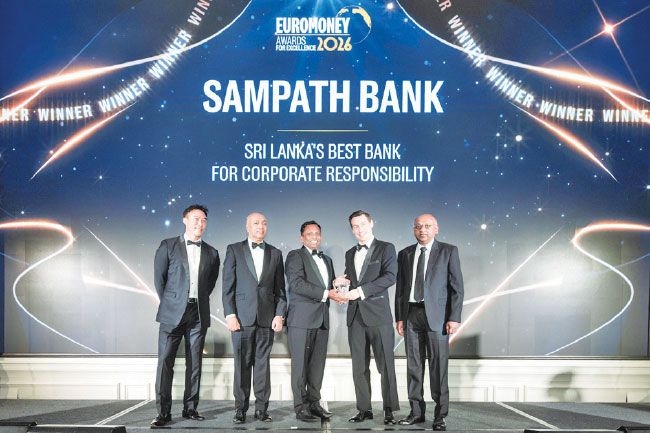
Sampath Bank PLC has been recognised as Sri Lanka’s Best Bank for Corporate Responsibility at the Euromoney Awards for Excellence 2026, highlighting its efforts in responsible banking and initiatives aimed at creating sustainable benefits for communities and the environment.
The award was presented at the Asia-Pacific regional awards ceremony held recently in Singapore. Euromoney, an international financial publication, presents its Awards for Excellence to recognise performance, leadership and innovation across the global banking and financial services industry.
The latest recognition reflects the scope of Sampath Bank’s corporate responsibility initiatives, with its flagship ‘Wewata Jeewayak’ programme playing a central role in its approach to community and environmental sustainability.
Sampath Bank Managing Director and Chief Executive Officer Sanjaya Gunawardana said the recognition reflects the bank’s belief that corporate responsibility should generate meaningful, measurable and long-term value for communities while contributing to national resilience.
He said the ‘Wewata Jeewayak’ programme demonstrates how environmental restoration can be linked with community resilience, food security, economic opportunities and climate adaptation. He added that the recognition would further encourage the bank to continue developing an integrated approach to sustainability and expanding its measurable impact.
The ‘Wewata Jeewayak’ programme expanded significantly in 2025, with Sampath Bank investing LKR 63.7 million, approximately USD 190,000, in 11 new tank restoration projects. The projects benefited 14,780 people and supported the rejuvenation of 3,370 acres of paddy cultivation.
The initiative forms part of Sampath Bank’s wider efforts to strengthen climate resilience and support rural development by restoring neglected irrigation tanks that serve as vital water infrastructure for agricultural communities across Sri Lanka.
Alongside the physical restoration work, the programme involves technical collaboration and engagement with farmers, government authorities and farmer organisations. These efforts are aimed at improving water management, strengthening agricultural practices and supporting the long-term maintenance and effective use of restored irrigation infrastructure.
Hayleys Solar Commissions 3MW Ground-Mounted Solar Power Project in Veyangoda