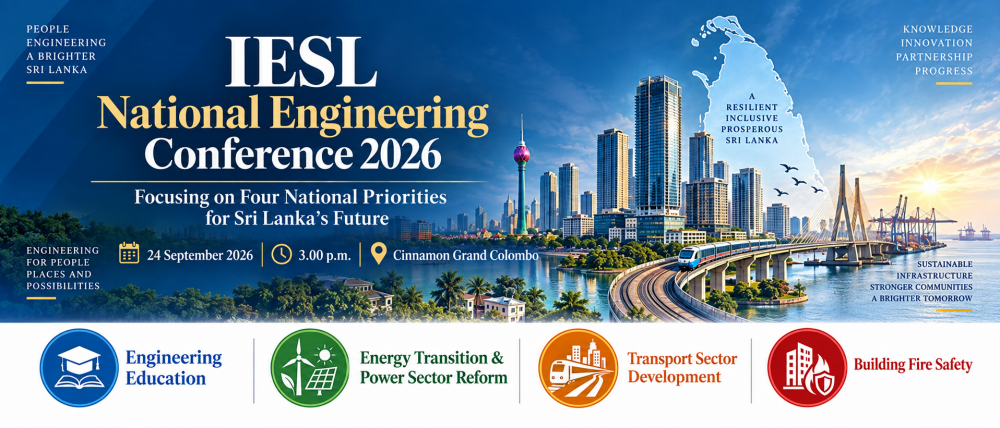
The Institution of Engineers, Sri Lanka (IESL), is set to host the National Engineering Conference 2026 on September 24 at Cinnamon Grand Colombo, bringing together policymakers, senior government officials, engineers, academics, industry leaders, investors and development partners to explore practical solutions to key national challenges.
Beginning at 3.00 p.m., NEC 2026 will go beyond the traditional format of a professional conference. IESL will present four policy papers developed by engineering professionals, with relevant authorities and stakeholders invited to consider concrete measures for implementation.
The policy discussions will focus on four key areas: engineering education, energy transition and power sector reforms, transport sector development, and building fire safety.
The first policy area addresses engineering, technology and technical education. Sri Lanka requires an education and professional development framework that meets national priorities while maintaining internationally recognised standards. The proposed framework calls for clearer distinctions between Engineers, Engineering Technologists and Engineering Technicians, supported by defined competencies, qualifications and career pathways.
It also emphasises accreditation, workforce planning and stronger connections between educational institutions, industry and professional practice. A structured approach could provide young people with clearer career opportunities while helping Sri Lanka build the technical and professional workforce required for future economic development.
The second area focuses on energy transition and power sector reform. According to the report, the key challenge facing the sector is increasingly one of implementation rather than a lack of policy.
The expansion of renewable energy, particularly solar and wind power, needs to be integrated with stronger transmission and distribution infrastructure, energy storage, forecasting, demand management and system control. At the same time, the sector must balance energy security, reliability, affordability, financial sustainability and environmental responsibility.
Fighting Sri Lanka’s Diabetes Surge Through Smarter Food Choices
Sri Lanka is facing a significant shift in its public health landscape, with diabetes and prediabetes becoming increasingly common among adults.
The Sri Lanka Health and Ageing Study found that nearly one in four adults has diabetes, while almost one in three is living with prediabetes. The findings point to a growing health challenge, particularly as diabetes is now being diagnosed at younger ages.
Type 2 diabetes, once more commonly associated with people around the age of 50, is increasingly being seen among those in their 30s. Prediabetes, which is considered an early warning stage, can also affect people as young as 20.
The growing prevalence of prediabetes is particularly important because this stage can often be improved, and in some cases reversed, through changes in diet, physical activity and other lifestyle factors. Understanding how the condition develops helps explain why these factors matter.
How Insulin Resistance Develops
Type 2 diabetes typically develops through a process known as insulin resistance. Although the body continues to produce insulin, cells become less responsive to it, making it harder for glucose to move from the bloodstream into cells where it can be used for energy.
Several biological factors can contribute to insulin resistance.
Excess body fat can cause harmful effects on tissues, a process known as lipotoxicity. At the same time, mitochondria — the structures responsible for producing energy inside cells — may become less efficient with age and inadequate antioxidant intake, potentially increasing oxidative stress.
Excess fat tissue can also act as an active endocrine organ, releasing inflammatory substances such as interleukin-6, tumour necrosis factor-alpha and angiotensin II. These substances can contribute to inflammation and further reduce the body's sensitivity to insulin.
IESL National Engineering Conference 2026 to Unite Engineering, Industry and Policy Leaders for Sri Lanka’s Future