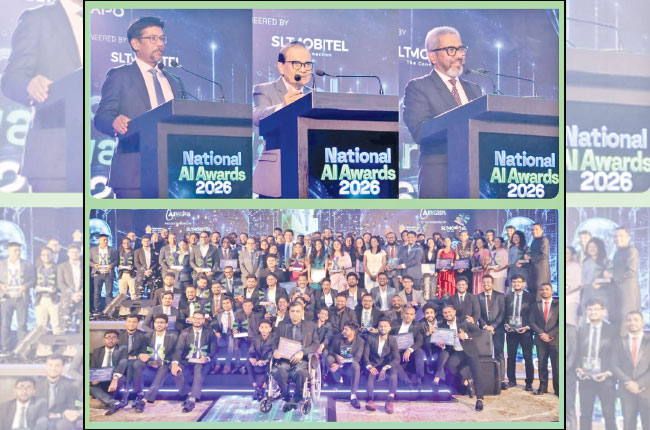
Sri Lanka’s inaugural National AI Awards 2026, the country’s first national awards programme dedicated to artificial intelligence (AI), concluded on September 30 at Monarch Imperial, marking the culmination of Sri Lanka AI Week 2026, the country’s largest AI-focused event to date.
Initiated by the Ministry of Digital Economy and SLT-MOBITEL, the week-long programme featured five major events: the AI Hackathon, AI Leaders Night, AI Conference, AI Exhibition and National AI Awards. The initiative brought together stakeholders to celebrate innovation, collaboration and advancements in artificial intelligence.
The National AI Awards recognised outstanding AI solutions, industry leaders and emerging talent, highlighting the growing role of artificial intelligence across Sri Lanka’s economy and society.
The awards ceremony was attended by Eng. Eranga Weeraratne, Deputy Minister of Digital Economy, as Chief Guest, alongside Waruna Sri Dhanapala, Secretary to the Ministry of Digital Economy; Dr. Mothilal De Silva, Chairman of SLT Group; and Riyaaz Rasheed, CEO of SLT-MOBITEL. Policymakers, industry representatives, academics and innovators also attended the event.
The awards showcased AI innovations across several sectors, including agriculture, healthcare, banking, education and enterprise solutions. Submissions were assessed by an independent panel of 19 judges, with evaluations focusing on quality, scalability and potential impact.
A total of 64 awards were presented across the programme, including 19 Gold Awards, 14 Silver Awards, 12 Bronze Awards and 18 Merit Awards, alongside the Sri Lanka AI Transformation Leader of the Year Award and the National AI Excellence Award for the Best Overall AI Solution Across All Sectors.
Chamira Prasad Jayasinghe, Founder and Chief Executive Officer of Arimac, received the Gold Award for Sri Lanka AI Transformation Leader of the Year. Emojot (Pvt) Ltd. secured the National AI Excellence Award for its project, Emojot UXI – Unified Experience Intelligence.
Sector-specific categories recognised AI applications in Agriculture, Banking, Finance and Insurance (BFSI), Healthcare and Life Sciences, Manufacturing (Industry 5.0), Education and Media.
The awards also highlighted emerging areas of innovation through categories recognising the Best AI Startup/MSME Innovation, Best Agentic AI Solution, Best Sinhala/Tamil AI and Localisation Innovation, University AI Innovation, Women in AI Leadership and AI Content Creator of the Year.
Ceybank Marks 35 Years of Steady Growth and Financial Stability
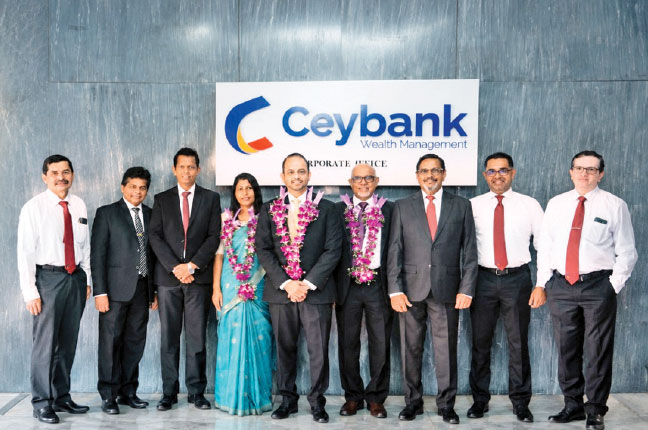
Ceybank Asset Management Ltd. has marked its 35th anniversary, celebrating three and a half decades of resilience, continuity and investment expertise.
The milestone was commemorated at a private gathering at the company’s corporate office in Colombo, bringing together shareholders and members of the leadership team to reflect on its achievements and future direction.
The event was attended by Kavinda de Zoysa, Chairman of Bank of Ceylon (BOC), highlighting the longstanding relationship between the two institutions. As Ceybank’s largest shareholder, BOC continues to play an important role in supporting the company’s financial strength and future growth.
Ceybank Asset Management Ltd. is jointly owned by four established institutions, each contributing distinct expertise and resources to its governance, investment capabilities and overall performance.
Bank of Ceylon, Sri Lanka’s largest state-owned commercial bank, holds a 44% stake in Ceybank. Its involvement provides financial stability, institutional credibility and access to an extensive nationwide distribution network.
Sri Lanka Insurance Corporation Ltd. (SLIC), one of the country’s leading state-owned insurers, holds a 26% shareholding. The institution contributes expertise in long-term financial planning and institutional investment, supporting Ceybank’s stability and reputation.
The Specified Undertaking of Unit Trust of India (SUUTI), a recognised institution in Indian investment management, holds a 17.5% equity stake. Its involvement brings technical expertise and broader strategic perspectives to the company’s investment operations.
Carson Cumberbatch PLC, a diversified regional conglomerate with an established investment track record, holds the remaining 12.5% stake, contributing its market experience and multi-sector business expertise.
As Ceybank celebrates 35 years in the industry, the anniversary provides an opportunity to reflect on its institutional partnerships and investment heritage while looking ahead to its continued development in Sri Lanka’s financial services sector.
National AI Awards 2026 Recognises Innovators Driving Sri Lanka’s AI Future