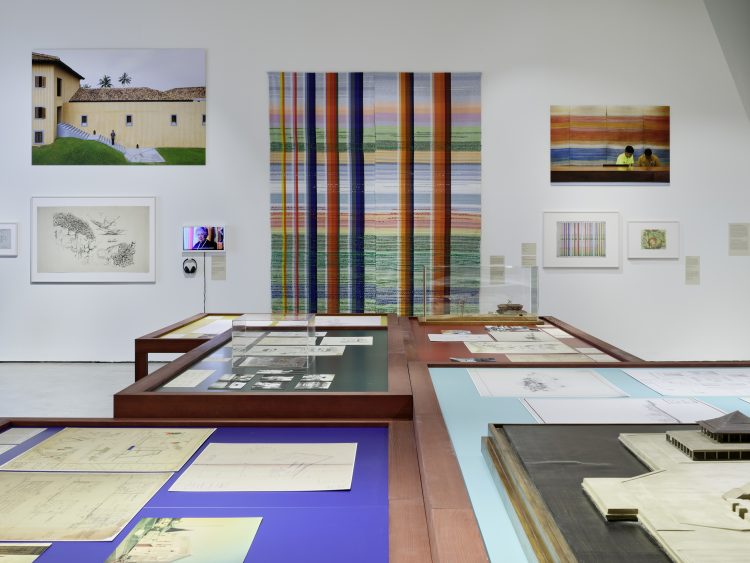
The Vitra Design Museum in Germany has opened a major retrospective celebrating the life and work of Geoffrey Bawa (1919–2003), one of Asia’s most influential architects of the 20th century. Titled Geoffrey Bawa: Architecture for the Senses, the exhibition explores the distinctive architectural vision of the Sri Lankan architect, whose work brought together modernist principles, local traditions and the natural environment.
Over a career spanning five decades and more than 200 projects, Bawa developed a distinctive architectural style across a diverse range of buildings, including private residences, schools, hotels, factories and Sri Lanka’s National Parliament.
Organised in partnership with the Geoffrey Bawa Trust, the retrospective features more than 250 exhibits, including architectural drawings, models, furniture, artworks, historical footage and photographs taken by Bawa. Newly commissioned photographs by renowned photographer Iwan Baan also capture the lived-in character of some of the architect’s most celebrated buildings.
The exhibition’s spatial design, created by architect Lina Ghotmeh, transforms the museum into an immersive environment that reflects the sensory qualities of Bawa’s architectural practice. The exhibition officially opened on September 25, attracting more than 450 attendees to an opening talk and over 500 visitors on the first day.
According to Mateo Kries, Director of the Vitra Design Museum, Bawa occupies a distinctive place in the history of modern architecture. His work, grounded in Sri Lanka’s diverse architectural traditions, offers an alternative perspective to Western-centred narratives that have traditionally shaped the architectural canon. Kries noted that the renewed interest in Bawa’s work presents an opportunity to introduce his vision to a wider international audience.
Johan Deurell, co-curator of the exhibition, highlighted Bawa’s sensitivity to the cultural, political and geographical contexts in which he worked. His understanding of the relationship between architecture and the senses, collaboration with local artisans and social enterprises, and commitment to working with nature rather than against it continue to inspire architects and designers.
Although Bawa is widely recognised as a pioneer of Tropical Modernism, the exhibition moves beyond this familiar classification to explore the broader dimensions of his work. It places particular emphasis on collaboration, ecological awareness and the cultural context of architectural design.
By examining these interconnected themes, the retrospective presents Bawa not only as an influential architect but also as a forward-thinking practitioner whose approach to socially responsible and sustainable design remains highly relevant to contemporary architectural challenges.
The exhibition celebrates Bawa’s enduring contribution to architecture while highlighting the international significance of Sri Lanka’s architectural heritage and its continuing influence on design thinking worldwide.
Internationally Acclaimed Play ‘Every Brilliant Thing’ Set to Premiere in Sri Lanka

The internationally acclaimed play Every Brilliant Thing is set to make its way to Sri Lanka this November, offering local audiences an engaging theatrical experience that explores hope, human connection and the small joys that make life meaningful.
The Peterite Arts Foundation, in association with World Vision Lanka, has announced a local amateur production of the celebrated solo play by Duncan Macmillan and Jonny Donahoe, arranged with Casarotto Ramsay & Associates Ltd. Directed by Theruni Indrapala, the production will feature former Peterite Mario de Soyza in the lead role. Performances will take place at Kamatha Studio, BMICH, Colombo, from 5 to 8 November 2026.
Every Brilliant Thing follows a narrator who, at the age of seven, begins compiling a list of everything worth living for in an attempt to help his mother cope with depression. Starting with simple pleasures such as ice cream, things with stripes and rollercoasters, the list eventually grows to more than a million entries, becoming a lifelong source of comfort and a reflection on resilience, love and the value of everyday experiences.
First developed as a short monologue in 2006, the play has since evolved into a global theatrical phenomenon, reaching audiences in more than 80 countries across five continents. Its message of hope has resonated with people in a wide range of settings, including a performance aboard the USS George H.W. Bush aircraft carrier. The production has also been translated into 44 languages, including Arabic and Greek, and has inspired a Chinese adaptation titled Every Brilliant Little Thing.
The play's distinctive combination of humour, emotional depth and audience participation has attracted performers from diverse backgrounds. Following a successful West End run featuring Sue Perkins and Minnie Driver, the production made its Broadway debut at the Hudson Theatre, where its run extended from 21 February to 9 August 2026.
Tony Award winner Daniel Radcliffe led the Broadway production at its opening, earning critical acclaim and a Tony Award nomination for Best Lead Actor in a Play. He was followed by Law & Order: SVU star Mariska Hargitay, who made her official Broadway debut in the role, and Golden Globe winner Tracee Ellis Ross, who concluded the Broadway run.
Vitra Design Museum in Germany Opens Exhibition Celebrating Geoffrey Bawa’s Architectural Legacy