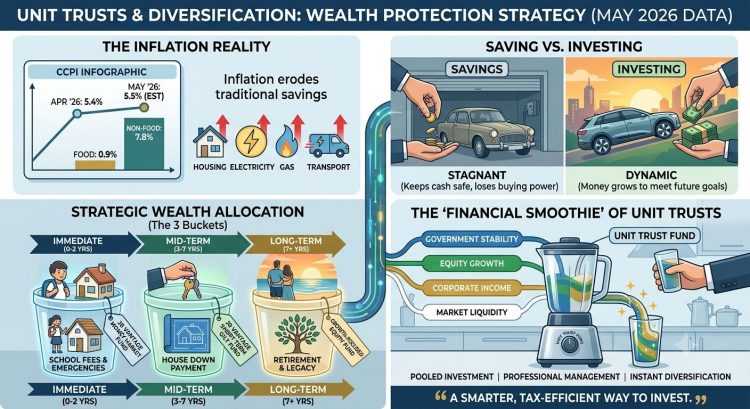





With inflation continuing to erode purchasing power, simply keeping money in a savings account may no longer be enough to preserve wealth. According to the latest Colombo Consumer Price Index (CCPI), inflation rose to 5.5% in May 2026 from 5.4% in April. While food prices increased modestly by 0.9%, non-food inflation climbed to 7.8%, driven largely by higher local energy prices amid ongoing geopolitical tensions in the Middle East.
For many savers, this presents a challenge. When inflation outpaces the interest earned on savings accounts—and even after-tax returns on fixed deposits—money gradually loses its real value. Essentials such as housing, electricity, gas, and transport become more expensive, reducing consumers' purchasing power over time.
While saving remains essential for financial security, investing plays a crucial role in growing wealth and keeping pace with inflation. A practical approach is to allocate money according to different financial goals and time horizons.
For short-term needs such as emergencies or school fees, funds should remain easily accessible in low-risk investments like the JB Vantage Money Market Fund. For medium-term goals, including a home down payment or children's education, investors may consider an income or balanced fund such as the JB Vantage Credit Opportunity Fund, which offers greater growth potential while managing risk. Long-term objectives, including retirement planning or wealth creation, can benefit from equity-focused investments like the JB Vantage Value Equity Fund, which is designed to generate long-term capital appreciation despite short-term market fluctuations.
Diversification is another key strategy for protecting wealth against inflation and market volatility. By spreading investments across multiple asset classes—including government securities, corporate debt, equities, and money market instruments—investors can reduce overall portfolio risk while improving the potential for consistent long-term returns.
However, constructing and managing a diversified portfolio independently requires significant expertise and ongoing market research. Unit trusts simplify this process by pooling money from multiple investors into professionally managed portfolios.
Christine Dias Bandaranaike, CEO and Portfolio Manager at JB Financial, said unit trusts offer an accessible and efficient way for individuals to build long-term wealth.
"For busy professionals, unit trusts are a practical and smart investment solution. They provide access to professional fund management while simplifying investment decisions. By pooling funds from multiple investors into diversified portfolios, unit trusts allow individuals to achieve broad market exposure and effective risk management through a single investment," she said.
She added that this diversified approach is similar to a "financial smoothie," combining government-backed stability, equity growth, corporate income, and market liquidity into one professionally managed portfolio, helping investors balance risk while pursuing stronger long-term returns.
Vallibel Finance Delivers Record-Breaking Growth

Vallibel Finance PLC sustained its strong growth momentum in FY2025/26, delivering outstanding financial results and further cementing its position among Sri Lanka’s top four financial institutions. Achieving this milestone within just 19 years of operations highlights the company’s rapid growth and long-term strategic vision.
For the financial year under review, Vallibel Finance recorded a Profit Before Tax (PBT) of Rs. 7.6 billion, representing a 37.5% increase compared with the previous year. Net Interest Income also rose by a strong 36.1% to Rs. 11.04 billion, reflecting the company’s ability to capitalize on market opportunities while maintaining prudent financial management and operational efficiency.
The company’s balance sheet continued to strengthen, with total assets expanding by 61.4% to Rs. 180.2 billion from Rs. 111.6 billion a year earlier. This growth was driven by healthy portfolio expansion, strong customer demand, and effective risk management across its range of financial products. Asset quality also improved significantly, with the Non-Performing Loan (NPL) ratio declining to 2.53% from 3.56%, underscoring disciplined credit management and enhanced portfolio performance.
These achievements build on another major milestone in Vallibel Finance’s growth journey, having become Sri Lanka’s fastest financial institution to surpass Rs. 100 billion in assets within just 17 years of operations. The accomplishment reflects the company’s sustained expansion, operational strength, and commitment to creating long-term value.
Further reinforcing its industry leadership, Vallibel Finance has been named "Best Finance Company" by The Global Economics for several consecutive years, recognising its excellence in service delivery, innovation, customer trust, and overall performance in Sri Lanka’s financial services sector.
The company’s strong financial position is further supported by an "A-" credit rating from the Lanka Rating Agency and an "A" Brand Rating from Brand Finance, reflecting its financial stability, brand strength, and continued commitment to delivering trusted financial solutions.
Protecting Wealth from Rising Inflation Through Unit Trusts and Diversification