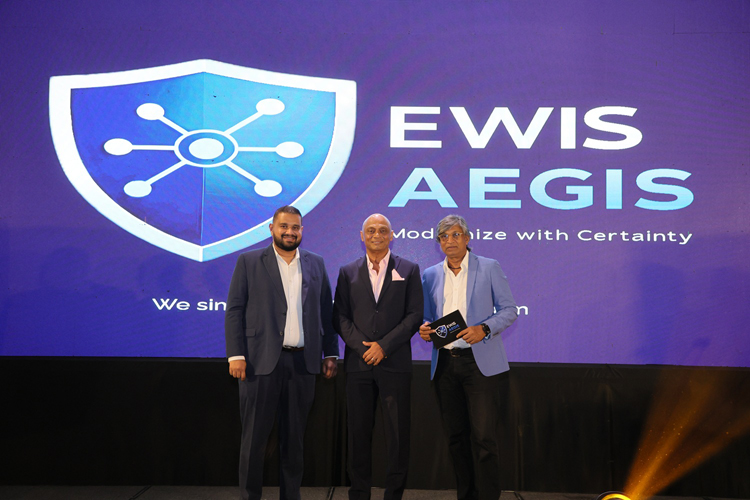





EWIS has announced the launch of EWIS AEGIS, a first-of-its-kind AI-powered platform developed in Sri Lanka to help organisations modernise mission-critical legacy systems with greater speed, control, and predictability. The platform integrates proprietary technology, for which a patent is currently pending.
Across industries including banking, insurance, government, telecommunications, and healthcare, legacy systems continue to support core operations. However, modernising these systems remains a complex, costly, and high-risk undertaking, often resulting in delays, budget overruns, and operational disruptions.
EWIS AEGIS addresses these challenges by enabling organisations to analyse, simulate, and validate system transformations before deployment—significantly reducing uncertainty and strengthening decision-making. Built on a “simulate before you transform” philosophy, the platform introduces a more controlled and predictable approach to modernisation.
Bringing a simulation-first methodology to legacy transformation—an area with limited global solutions—EWIS AEGIS allows organisations to modernise without disrupting critical operations. It stands among the few platforms in the region capable of delivering full legacy system simulation prior to transformation.
The platform is designed to deliver measurable outcomes by reducing transformation risks through early validation, accelerating timelines through proactive issue identification, and minimising downtime in mission-critical environments. It also enhances cost predictability by reducing rework and lowering failure rates, ensuring a more efficient and reliable transformation process.
Commenting on the launch, Sanjeewa Wickramanayake, Chairman of EWIS Group, stated that legacy system modernisation has traditionally been associated with significant risk. He noted that EWIS AEGIS enables organisations to move from uncertainty to control by understanding outcomes before implementation and executing transformations with confidence.
EWIS AEGIS combines multiple advanced capabilities, including AI-driven code intelligence to extract and structure legacy system logic, dependency mapping to identify hidden relationships and risks, and digital twin simulation to replicate system behaviour before changes are made. The platform also features automated transformation to support seamless migration to modern architectures, along with AI-powered testing to ensure accuracy and maintain data integrity throughout the process.
Agoda names Galle among Asia’s top destinations for slow travel

Agoda is inviting travellers to embrace the art of slow travel through a curated selection of destinations across Asia. These locations offer opportunities to immerse in local culture, explore at a relaxed pace, and build meaningful connections with each destination. As travellers increasingly prioritise authentic and enriching experiences, slow travel is gaining momentum as a way to fully appreciate the journey while creating lasting memories.
This shift reflects a growing preference for experiences over tightly packed itineraries, with travellers seeking deeper connections through food, cultural traditions, and time spent in nature. In these destinations, the focus is less on ticking off landmarks and more on how visitors engage with the essence of a place.
Agoda’s selection spans heritage towns, cultural centres, and nature-rich regions, each offering its own unique rhythm:
Hoi An
Hoi An’s compact old town encourages exploration on foot or by bicycle. Beyond its iconic lantern-lit streets, travellers can engage in hands-on experiences such as tailoring custom garments, joining cooking classes that begin with local market visits, or cycling through rice paddies to nearby coastal villages. Its rich trading history is reflected in a blend of Vietnamese, Chinese, and Japanese architectural and culinary influences.
Ubud
Ubud is known for its harmonious balance between natural beauty and creative expression. Days often begin with walks through terraced rice fields such as Tegallalang, followed by visits to artist studios and craft workshops specialising in wood carving and batik. Wellness remains central, with yoga, meditation, and traditional Balinese healing practices forming part of everyday life.
Kyoto
Kyoto offers a more structured approach to slow travel, shaped by tradition and seasonality. Visitors move between neighbourhoods to experience tea ceremonies, tranquil temple gardens, and seasonal cuisine such as kaiseki dining. Scenic walking routes, including the Arashiyama bamboo grove, encourage a reflective pace closely aligned with nature.
Galle
Within the historic walls of Galle Fort, life unfolds at a gentle pace. Travellers can spend time exploring restored colonial villas, independent galleries, and boutique cafés, all set against the backdrop of the Indian Ocean. Beyond the fort, the surrounding coastline offers quieter beaches, while local artisans continue long-standing traditions in lacemaking and jewellery.
Luang Prabang
Luang Prabang is celebrated for its tranquil atmosphere and cultural richness. Situated between the Mekong and Nam Khan rivers, this UNESCO World Heritage site invites visitors to explore ancient temples, take part in traditional almsgiving ceremonies, and enjoy leisurely boat rides. Its blend of French colonial architecture and Laotian heritage creates a distinctive setting for slow travel.
Chiang Mai
Chiang Mai combines deep cultural roots with access to northern Thailand’s natural landscapes. Visitors often centre their stay around temple visits, meditation retreats, and cooking classes focused on regional Lanna cuisine. Beyond the city, travellers can explore mountain communities, national parks, and ethical elephant sanctuaries.
Kerala
Kerala’s slower pace is best experienced along its serene backwaters, where houseboat journeys glide past villages, coconut groves, and paddy fields. On land, travellers can visit spice plantations, attend traditional Kathakali performances, or take part in Ayurveda-based wellness programmes. The region’s cuisine—rich in coconut, seafood, and aromatic spices—plays a central role in the overall experience.
EWIS launches EWIS AEGIS, an AI-driven platform designed to reduce risks in enterprise legacy modernisation