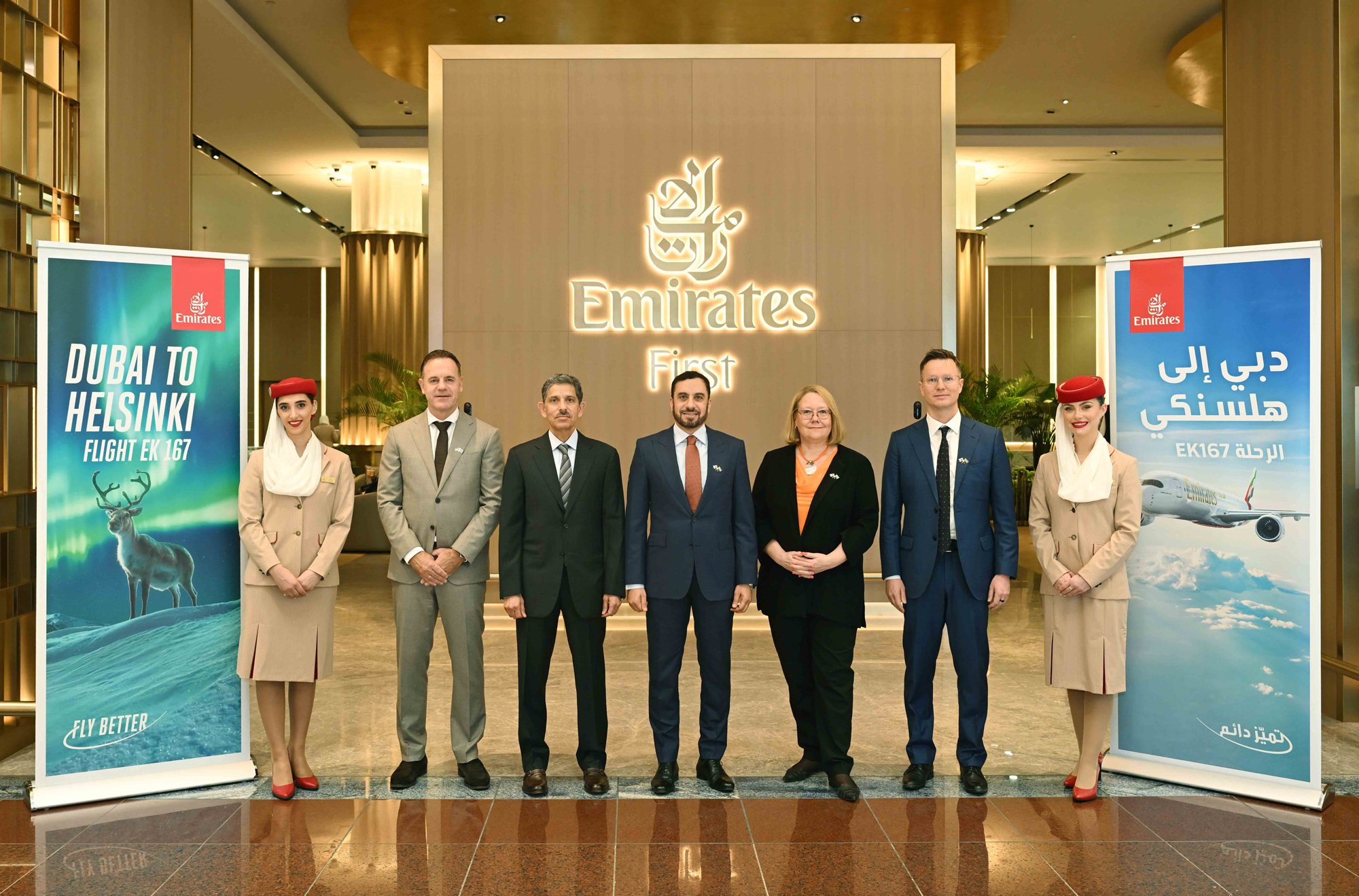
Emirates has launched its first-ever flight from Dubai to Helsinki, Finland, opening a new direct connection between the United Arab Emirates and the Finnish capital.
Emirates flight EK167 departed Dubai at 7.30 a.m. with a near-full passenger and cargo load, carrying a VIP delegation and media representatives on the inaugural service.
The new route provides the only year-round direct connection between the UAE and Finland, while offering travellers from Helsinki access to almost 140 destinations across Emirates’ global network. The service is expected to strengthen connectivity between Finland and key markets across Australia, Africa, Asia and the Middle East.
Among the distinguished guests onboard was Lieutenant Colonel Juma Abdulla Obaid Bin Subaih Alflasi, Acting Director of Passport Control, Terminal 3, General Directorate for Identity and Foreigners Affairs (GDRFA).
The inaugural flight also carried His Excellency Mohamed Rashid bin Taliah, Assistant Minister of Cabinet Affairs for Government Knowledge Exchange, together with delegates representing areas of cooperation between Finland and the UAE, including cybersecurity, digital transformation, energy, trade and education.
Her Excellency Tuula Yrjölä, Ambassador of Finland to the UAE and Bahrain, and Jorge Fernández Gates, Senior Advisor at the Embassy of Finland in Abu Dhabi, also travelled on the inaugural flight.
Omar bin Ghaleb, Deputy Director General of the General Civil Aviation Authority, and Samuli Pesu, Chairman of the Finnish Business Council UAE, were among the other officials and business representatives onboard.
The Emirates delegation was led by Adnan Kazim, Deputy President and Chief Commercial Officer, and Jeffrey Van Haeften, Senior Vice President of Cargo Commercial Worldwide, Emirates SkyCargo.
The new daily service is operated with an Airbus A350, the latest aircraft type to join Emirates’ all-widebody fleet. The aircraft accommodates 298 passengers across three cabins — Business Class, Premium Economy and Economy — bringing Emirates’ latest onboard products and services to Finland from the launch of the route.
Maldives’ 40% Dollar Conversion Rule Could Boost Sri Lanka’s Tourism Sector

On 31 August 2026, Maldivian President Mohamed Muizzu signed the First Amendment to the Foreign Currency Act into law, together with six other pieces of legislation. The new amendment took effect just one day later, on 1 September 2026.
While the change arrived amid a broader package of new laws, its implications for the country's tourism industry could be significant. The legislation introduces a series of foreign-exchange measures that may alter the operating environment for resorts, hotels and tourist vessels, while potentially reshaping the Maldives' competitive position within the wider Indian Ocean tourism market.
One of the most notable changes is the increase in the mandatory foreign-currency conversion requirement for Category A Tourism Establishments. Resorts, hotels and tourist vessels must now convert 40% of their monthly gross sales into local currency, up from the previous requirement of 20%.
The amendment also removes the previous option that allowed businesses to meet the requirement based on a fixed amount of USD 500 per tourist arrival. At the same time, the revenue threshold used to classify an entity as a "high-income entity" has been increased from USD 15 million to USD 25 million.
Another important change requires businesses to obtain prior approval from the Maldives Monetary Authority (MMA) before making or receiving foreign-currency payments for goods and services. The legislation provides limited exemptions, including certain transactions involving salaries, dividends and related-party payments.
Viewed separately, these provisions may appear to be technical adjustments to the country's foreign-exchange framework. Collectively, however, they represent a major intervention in the financial structure of the Maldivian tourism sector, with potential consequences extending well beyond the country's resorts.
Why the 40% Requirement Matters
The significance of the new 40% requirement becomes clearer when the underlying economics of a Maldivian resort are considered.
A resort in the Maldives operates very differently from a conventional hotel in destinations such as Colombo, Phuket or Victoria. Its business model is heavily dependent on imported goods, international financing and foreign-currency transactions. In many respects, a Maldivian resort functions almost like an offshore operation, with a large proportion of its essential inputs sourced or priced in foreign currency.
Industry estimates indicate that more than 90% of a typical resort's operating costs may be denominated in US dollars. These expenses can include imported food and beverages, fuel, equipment and spare parts, insurance and reinsurance, as well as repayments on resort development loans denominated in foreign currencies.
Foreign currency also plays an important role in payroll. Expatriate workers, and increasingly some local employees, may receive part or all of their compensation in US dollars.
This creates a fundamental mismatch between the currency in which resorts generate much of their revenue and the currency in which they are required to meet certain domestic obligations.
The Maldivian Rufiyaa is primarily needed for expenses such as government charges, local taxes and portions of domestic payroll. For many of the other major costs associated with running a resort, US dollars remain the preferred and often necessary currency.
Emirates Expands European Network with Flights to Helsinki