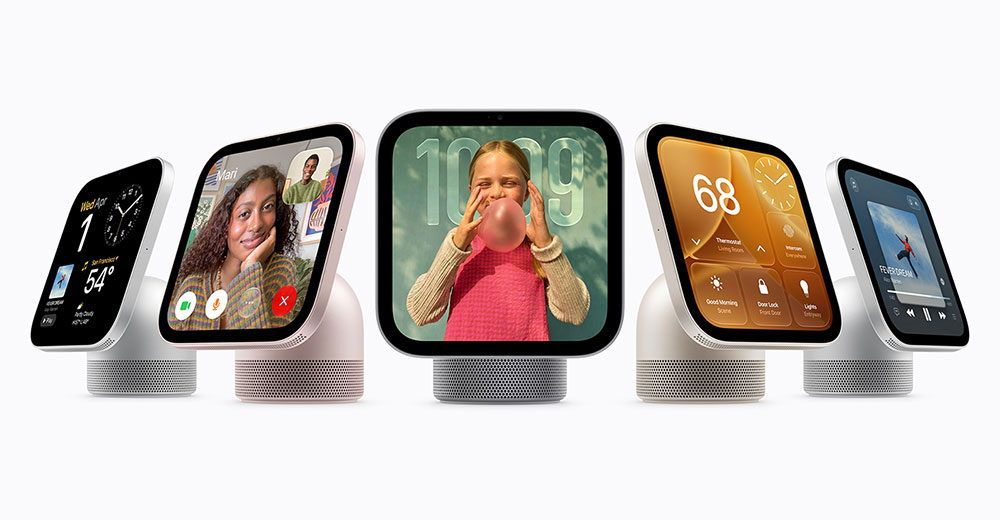
Apple has unveiled a new smart home device called HomeView, expanding its presence in the connected home market with a product that combines a touchscreen display, built-in audio and intelligent home controls.
The newly introduced device features a seven-inch Liquid Retina display attached to a rounded speaker base through a stainless-steel hinge, allowing users to adjust the screen's viewing angle. Apple is also offering a wall-mounted version for users who prefer a fixed installation.
The tabletop edition, pictured above, will be available in four colour options: silver, starlight, rose pink and space gray. Meanwhile, the wall-mounted model will come in silver and space gray. Both versions are priced at US$299, with pre-orders already underway and general availability scheduled to begin on November 13. Compatible wall-mounting accessories are sold separately, with prices starting at US$59.95.
According to Greg Joswiak, Apple's senior vice president of worldwide marketing, HomeView has been developed to provide a shared household experience while maintaining personalised features for individual family members.
He explained that the device can identify users through facial recognition and automatically display relevant personal information. It also combines room-filling audio, FaceTime communication and convenient controls for compatible smart home devices.
Apple Intelligence and Personalised User Experiences
HomeView is powered by Apple Intelligence and incorporates the company's Siri AI technology, which will initially be introduced in beta. Apple notes that accessing personal-context capabilities requires a compatible Apple Intelligence-enabled iPhone or iPad paired with the device, with Siri AI activated.
Ross Rubin, principal analyst at New York-based consumer technology advisory firm Reticle Research, highlighted personalisation as one of the product's major strengths.
He noted that HomeView can recognise as many as six household members and present information tailored to each individual without transmitting their personal information to Apple.
Rubin also explained that even Siri requests processed through cloud services use an identifier rather than an Apple ID, helping prevent those requests from being directly associated with a user's identity.
Familiar Apple Design With an Ecosystem Limitation
Rob Enderle, president and principal analyst at the Enderle Group, described HomeView as a capable smart display that combines Apple's familiar minimalist design approach with its underlying technology.
However, he raised concerns about the device's reliance on Apple's ecosystem. In his view, this requirement could discourage consumers who prefer greater flexibility across different technology platforms.
While the product may appeal strongly to customers already invested in Apple's ecosystem, its limited compatibility with other platforms could make it less attractive to users looking for a more open smart home solution.
HP Launches Future of Work Accelerator to Address AI's Impact on Entry-Level Jobs

I joined a panel of judges that included Antara Lahiri, director of the Micron Foundation for Asia Pacific and Europe; Catherina Gioino, a multimedia journalist and urbanist; and Michele Malejki, HP's global head of social impact and executive director of the HP Foundation. Mariama Kabia, who oversees HP's Accelerator program, also participated in the event.
Our responsibility was to assess organisations developing initiatives that help young people and underserved communities acquire relevant skills, gain practical experience and prepare for employment opportunities in an increasingly AI-driven economy.
The presentations highlighted several approaches to improving career readiness and helping individuals navigate changes in the employment landscape. Here are some of the key issues and ideas that emerged from the discussions.
Addressing Challenges in the Global Employment Market
Artificial intelligence is reshaping the global workforce, creating new demands for people entering the job market. During the Pitch Fest, participating organisations presented initiatives designed to provide practical experience, accessible training and stronger connections with potential employers.
The Future of Work Accelerator is a collaborative programme established by HP Inc. and the HP Foundation, with training support provided by MIT Solve and Global Impact Advisors. Its primary objective is to improve access to technology, workforce development opportunities and economic advancement.
Organisations selected for the programme receive a comprehensive support package that includes US$100,000 in financial assistance, an additional US$100,000 worth of HP technology and solutions, and six months of virtual training.
The importance of such initiatives becomes clearer when considering the growing influence of AI on employment opportunities and the challenges facing the next generation of workers.
AI-Driven Job Displacement and Gaps in Education
The growing impact of artificial intelligence on employment has become an increasingly important subject, particularly in relation to what can be described as the 'price parity trap'. For many years, the technology industry has maintained that automation would create new career opportunities even as it transformed traditional roles. However, AI is putting this assumption to the test, especially for individuals seeking their first professional positions.
Unlike earlier waves of automation, generative AI extends beyond physical activities and repetitive administrative tasks. It can also perform cognitive functions involving research, analysis, content creation and other knowledge-based activities. In certain entry-level roles, these systems are increasingly capable of completing tasks at competitive speeds and costs.
As businesses introduce AI tools to handle activities such as basic software development, initial research and preliminary document preparation, some of the routine assignments traditionally given to junior employees could become less common.
These responsibilities have historically provided newcomers with valuable opportunities to develop professional skills, gain workplace experience and progress into more advanced positions.
As a result, employers, educational institutions and workforce development organisations face an important challenge: finding alternative ways to help young professionals acquire the practical knowledge and experience needed to build sustainable careers in an AI-driven economy.
Apple Introduces HomeView, a New Smart Home Hub With a Seven-Inch Display