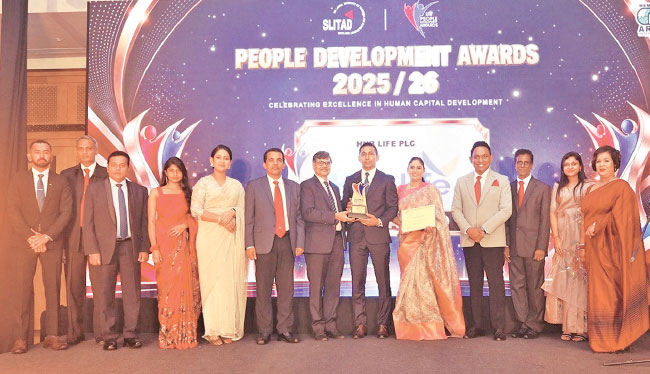
HNB Life PLC has secured the Gold Award at the SLITAD People Development Awards 2025/26, marking a significant achievement in the company’s efforts to foster a high-performance workplace culture centred on employee development and growth.
Organised by the Sri Lanka Institute of Training and Development (SLITAD), the awards recognise organisations that demonstrate excellence in talent development, workforce readiness and the implementation of effective employee development initiatives.
The recognition marks HNB Life’s first Gold Award at the SLITAD People Development Awards, highlighting its continued commitment to creating a workplace where employees are encouraged to learn, develop their capabilities and reach their full potential.
Commenting on the achievement, HNB Life Executive Director and Chief Executive Officer Lasitha Wimalaratne said the company considers its employees its greatest strength, adding that the award reflects a shared commitment to fostering a culture of learning, innovation, collaboration and professional growth.
HNB Life EVP and Chief People Officer Navin Rupasinghe described the Gold Award as an important milestone for the organisation, recognising its efforts to provide meaningful learning opportunities, support career development and create an engaging environment where employees can perform at their best.
He further emphasised that HNB Life would continue to strengthen and innovate its people management practices to respond to the evolving needs of its workforce and the changing demands of the future workplace.
Sri Lanka Launches Its First Agri-PV Pilot Demonstration Project in Kandy
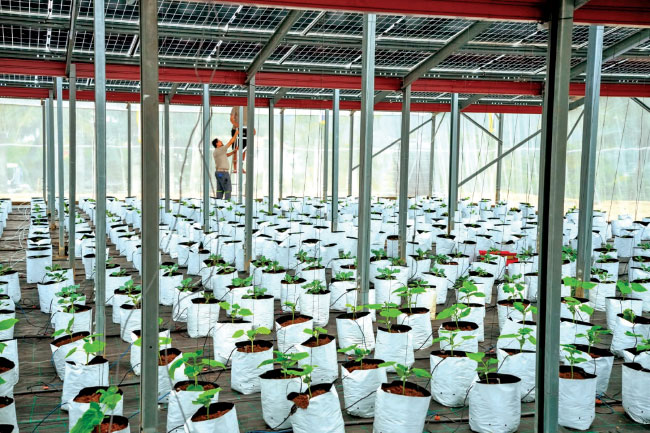
Sri Lanka has taken a step towards integrating renewable energy with agriculture with the opening of its first Agri-Solar Pilot Demonstrator for Training and Research at the National Seminary of Our Lady of Lanka in Ampitiya, Kandy, on October 23.
The project introduces agrivoltaics, also known as Agri-PV, a technology that combines solar photovoltaic (PV) electricity generation with agricultural cultivation on the same land. By enabling crops to grow beneath elevated solar panels, the approach aims to maximise land use while exploring opportunities to support both renewable energy production and agricultural productivity.
The initiative is supported by Germany’s Federal Ministry for Economic Affairs and Energy (BMWE) through the Renewable Energy Solutions (RES) Programme under the German Energy Solutions Initiative, with assistance from the German Energy Agency (dena). It aims to bring German renewable energy expertise to Sri Lanka while facilitating technology transfer, practical training and applied research.
Germany-based SUNfarming International GmbH provides the Agri-PV technology and engineering expertise, while SUNfarming Lanka (Pvt) Ltd oversees local implementation in collaboration with the National Seminary, which serves as the host institution.
The facility has a total installed solar PV capacity of 51.48 kWp, comprising elevated Agri-Solar structures and a separate modular installation for practical photovoltaic training. The elevated structures feature SUNfarming-branded bifacial glass-glass solar panels, allowing agricultural activities to continue beneath the installations.
The system incorporates a specially designed panel configuration intended to shield crops from heavy rainfall and intense sunlight. The design may also help reduce soil moisture loss and crop stress, depending on local growing conditions.
Beyond demonstrating the technology, the pilot facility will provide a practical platform for researchers and agricultural specialists to assess the suitability of different crops and cultivation techniques under Sri Lankan conditions. Ongoing monitoring will help generate data on crop performance, growing environments and the practical application of Agri-PV systems in the country.
Skills development is another key component of the initiative. During the installation phase, 26 trainees from the Ceylon German Technical Training Institute (CGTTI) gained hands-on experience working alongside the German engineering team.
The demonstrator is expected to support further technical training, technology demonstrations and practical learning in solar PV and Agri-PV applications, helping build local expertise in the emerging field of agriculture-integrated renewable energy.
HNB Life Secures Gold at SLITAD People Development Awards