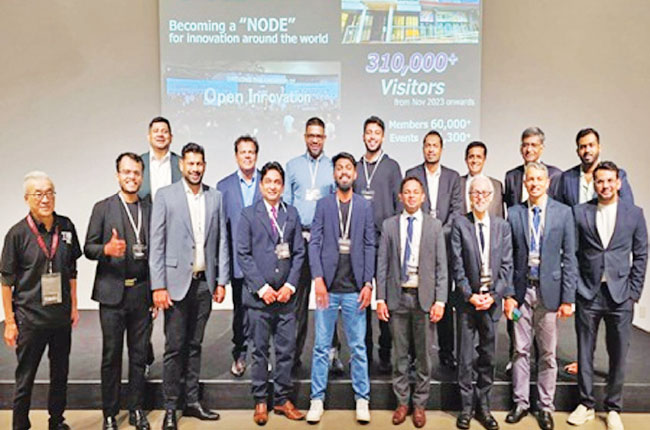





Sri Lankan Information and Communication Technology (ICT) companies took part in Japan IT Week Spring 2026, held from April 6 to 10 at Tokyo Big Sight, in collaboration with the Sri Lanka Export Development Board, Japan International Cooperation Agency, and the Embassy of Sri Lanka in Japan.
At the vibrant “Sri Lanka Pavilion,” ten ICT companies from Sri Lanka showcased cutting-edge solutions across artificial intelligence, IoT, software development, IT-enabled services, and other digital innovations. Their strong presence drew significant attention from global investors, industry leaders, and potential partners, further reinforcing Sri Lanka’s position in the global technology and innovation landscape.
This marks Sri Lanka’s second participation in the exhibition, representing a key milestone in the ongoing collaboration between the Export Development Board and JICA, launched in 2024 to strengthen the country’s ICT footprint in the Japanese market. The initiative supports around 30 ICT/BPM companies—including SMEs and startups—through tailored business coaching, market insights, and targeted matchmaking opportunities with Japanese industry stakeholders.
Ahead of the main exhibition, the delegation engaged in a series of structured activities, including business briefings, site visits, seminars, and networking sessions, aimed at maximizing engagement and partnership opportunities.
Participation in one of Asia’s leading technology exhibitions has further elevated the global visibility of Sri Lanka’s ICT sector while deepening the growing digital partnership between Sri Lanka and Japan. Such collaborative efforts continue to pave the way for a more innovative, connected future, unlocking new international opportunities for Sri Lanka’s ICT industry.
Sri Lanka’s services and exports sustain growth momentum despite a dip in March
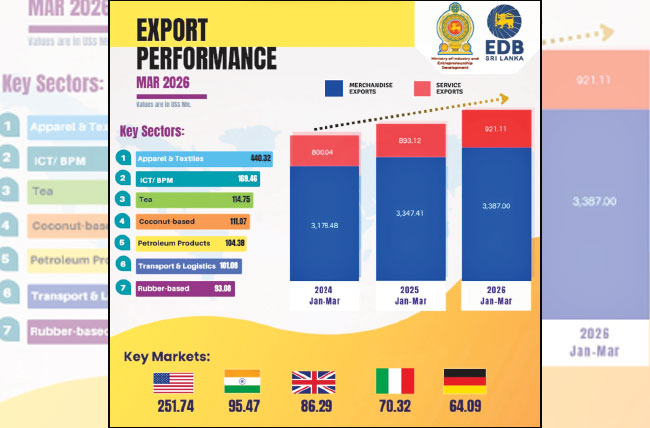
Sri Lanka’s services export sector demonstrated continued resilience in the first quarter of 2026, maintaining steady growth despite a moderate dip in March, according to official data.
Earnings from services exports were estimated at US$ 286.92 million in March 2026, reflecting a 6.26% year-on-year decline. However, on a cumulative basis, the sector sustained its upward momentum, with total earnings rising by 3.13% to US$ 921.11 million during the January–March period.
The figures highlight the growing importance of services within Sri Lanka’s export portfolio, as the country continues to diversify beyond traditional merchandise exports. Key segments such as ICT/BPM, financial services, construction, and transport and logistics played a vital role in supporting export performance.
Among these, ICT and Business Process Management (BPM) services stood out as a key growth driver. Export earnings from the sector surged by 31.15% to US$ 468.72 million in the first quarter, with March alone contributing US$ 169.46 million—up 26.48% year-on-year. This strong performance underscores Sri Lanka’s expanding presence in the global digital services market.
Financial services also recorded notable growth, increasing by 38.23% to US$ 17.87 million in the first quarter. In March, the sector saw a sharp rise of 74.53% year-on-year to US$ 6.82 million, reflecting improved cross-border financial activity and rising demand for specialised services.
However, some segments faced challenges. Transport and logistics exports declined by 16.35% to US$ 409.22 million in the first quarter, with March earnings falling by 33.73% to US$ 101.08 million, largely due to global trade disruptions and reduced shipping activity amid geopolitical uncertainties. Construction services exports also contracted by 24.67% to US$ 25.29 million, with March figures down 38.99% year-on-year to US$ 9.56 million.
Despite these setbacks, overall services exports remained on a growth path, supported by strong gains in high-value, knowledge-based sectors. Industry analysts note that the continued expansion of ICT/BPM and financial services signals Sri Lanka’s ongoing transition towards a more knowledge-driven economy.
Sri Lankan ICT companies are strengthening the Sri Lanka–Japan technology partnership by participating in Japan IT Week 2026